Vintage Movado watches explored in-depth | VIDEO
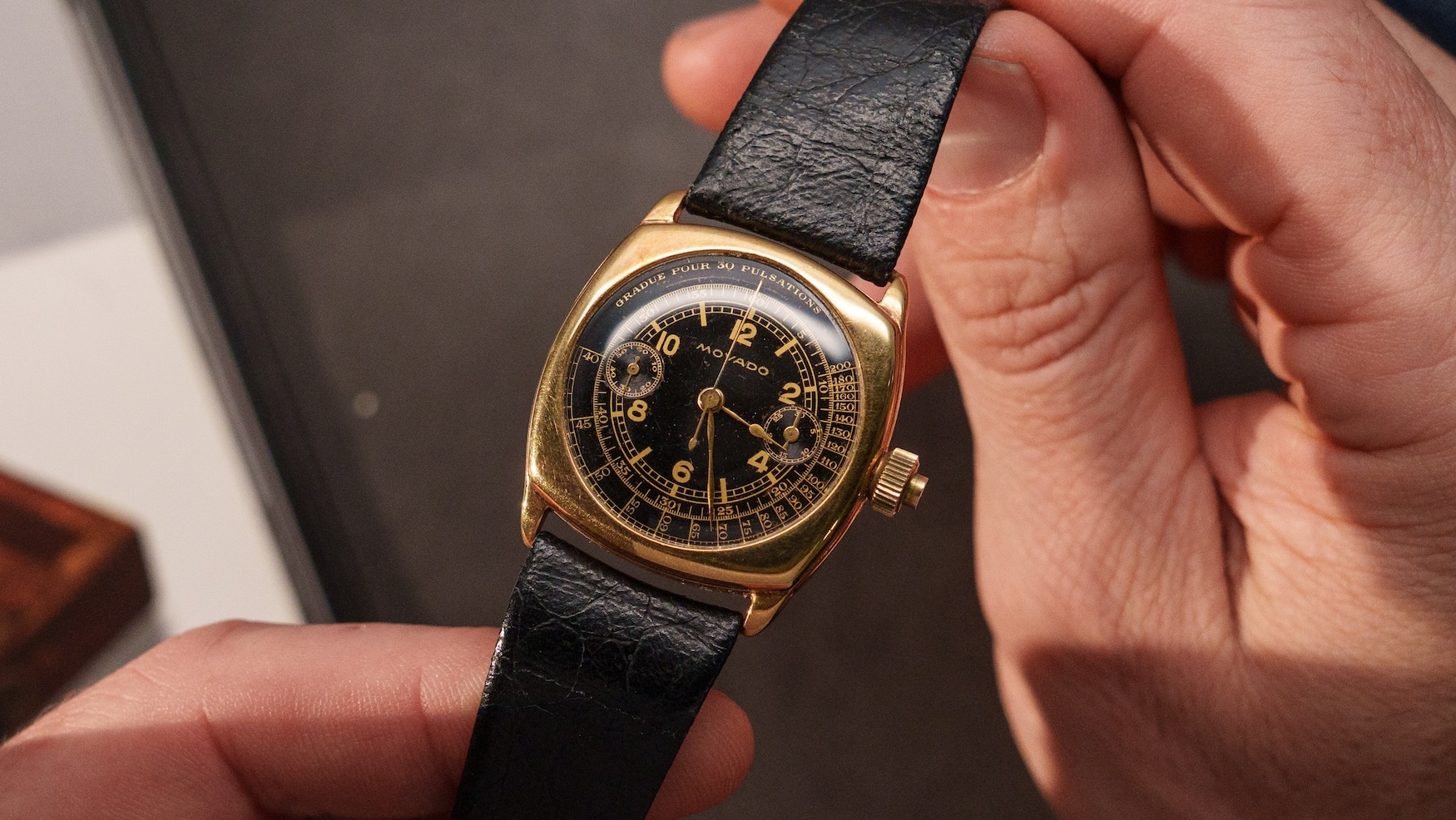
17.11.26 Time+Tide Ask most people about Movado, and you’ll get the same answer: the Museum watch. It’s a fair response, as that dial is the brand’s icon, but it is far from the whole story. Movado has been making watches in the Swiss Jura for 145 years, and in roughly six decades it filed close to 100 patents. A table of vintage Movado watches, laid out chronologically at Movado’s archive room at its USA headquarters, proved just how much the brand really is beyond one famous watch/dial. Zach and Marcus had to do everything they could not to drool over these vintage pieces – especially since many were not very water-resistant! Zach was joined by Joeham, a senior designer at Movado who focuses on the brand’s heritage. He even brought a 14k automatic from the mid-1950s from his own collection, which is exactly the sort of commitment we like to see. If you’re not getting high on your own supply, can we really trust you? Joeham’s genuine passion for vintage Movado made him the perfect man to walk through decades and decades of vintage pieces in-depth. The Polyplan and the birth of the wristwatch We began where Movado began, with the Polyplan. Produced from 1912 into the late 1920s, it houses a movement arranged on three different planes so that it curves around the wrist. Ergonomics was the entire point. Every wheel sits on the dial side, which is why the movement looks rather plain from the back, but it keeps the watch remarkably slim. The cases open on a hinge, and you can see the design evolving over the years, from gold and silver examples with intricate engraving to one with an integrated bracelet that Joeham believes is the only one known to exist. Remember, this is the very beginning of the wristwatch as a category, and Movado was already building curved movements . Today, perhaps one or two manufacturers attempt it because it is so difficult. Nearby sat the piece that inspired the current 1917 collection, a petite, thin calibre that suited men and women alike. Chronometers, chronographs and a patented bezel Honestly, there wasn’t a watch on that table we wouldn’t wear. But if there was one Zach would have wanted to run out the doors with, it would have been this Valjoux 13-powered Movado monopusher from the 1920s. The 1920s monopusher, with its cushion case and symmetrical layout, predates Movado’s own chronograph movement and is such a good-looking watch. Good thing it has a pulsometer scale , because Zach’s heart was racing looking at it. By the 1930s, Calibre 75 was the workhorse. The one we looked at is a chronometer adjusted in four positions, in a water-resistant case, with a radium dial that has developed a tropical patina you simply can’t replicate. Beside it sat a 37.5mm pilot’s watch, its rotating bezel and crystal one friction-fit piece. This design meant it was not the most water-resistant, but engaging with the timing scale is super smooth and easy to use. Then there’s the Cronoplan, which carries a Movado patent for its dual-directional bezel: a 60-minute chapter ring outside, a second scale inside. We’ve seen dual scales since, but never done this elegantly, and certainly not on a case this thin. The Calibre 90 and a prototype that never was This is where Zach really started to drool. In 1938, Movado released the Calibre 90, its first in-house chronograph, built as a modular mechanism that was the first of its kind at the time. The pushers are inverted, so the bottom pusher starts and stops where you’d expect the reset. Pick one up and press them in the right order, or you may be facing a nasty service bill. Add applied Breguet numerals , sword hands and a serpent minute-counter hand, and it was really the pick of the table. If you’re hunting a vintage chronograph of this era and style, look to Movado before chasing the big-name icons at auction. The real curveball was a one-of-one prototype reversible chronograph, with the registers on one side and the time-telling on the other. It never reached production, and whether Jaeger-LeCoultre had any involvement is unknown. The Reverso was only a few years old at the time, and Jaeger-LeCoultre didn’t make a Reverso chronograph until the 1990s. The way the chronograph pushers are not actually pushers, and instead slide akin to how you would actuate a minute repeater, was a fascinating twist for arguably the most intriguing piece on the table. The 1940s and 1950s: world timers and bumper automatics A worldtimer follows, with a rotating 24-city ring and a crescent-tipped GMT hand. Then the 331, a bumper automatic. Movado’s first automatic, the Tempomatic, arrived in the mid-1940s and was rather thick, but by 1950 the brand had slimmed the movement to just 4.3mm. Handwound watches that thin are not unheard of, but an automatic? That makes it a rarer member of an elite group. Add a polished dial with a textured central square and a distinctly groovy feel, and we’re sold. The 1960s and 1970s: Kingmatic, Zenith and El Primero A modern Kingmatic (left) displayed against the vintage model it was inspired by (right). The early-1960s Kingmatic Surf inspired today’s Kingmatic revival. Its cushion case measures 29mm, scaled up to 35mm for modern wrists, and its screw-down case back carries the Helios sun-chariot logo. The Calibre 95 chronograph has a glossy black dial with foil numerals that are hard to read but cool beyond words, and those same inverted pushers. A vintage El Primero-driven Movado chronograph (left) is shown with the modern time-and-date Tempomatic (right) inspired by it. Finally, a mid-1970s TV-shaped chronograph that inspired the new Tempomatic. It’s powered by El Primero , as Movado and Zenith teamed up in 1969, and these watches carry either name, plus a square logo that existed only in that period. The Ermeto and the Museum Two last stops. The Ermeto, introduced in 1926, slides open and shut in its shell, and from 1927 that motion winds the watch. It’s an energy accordion, and it feels brilliant. Then the Museum, created in 1947 and adopted by Movado in the 1960s, stripped of numerals and left with a single dot at twelve. That’s a story for another episode. Be sure to stay tuned...