The Wild True Story Behind 'I Play Rocky'
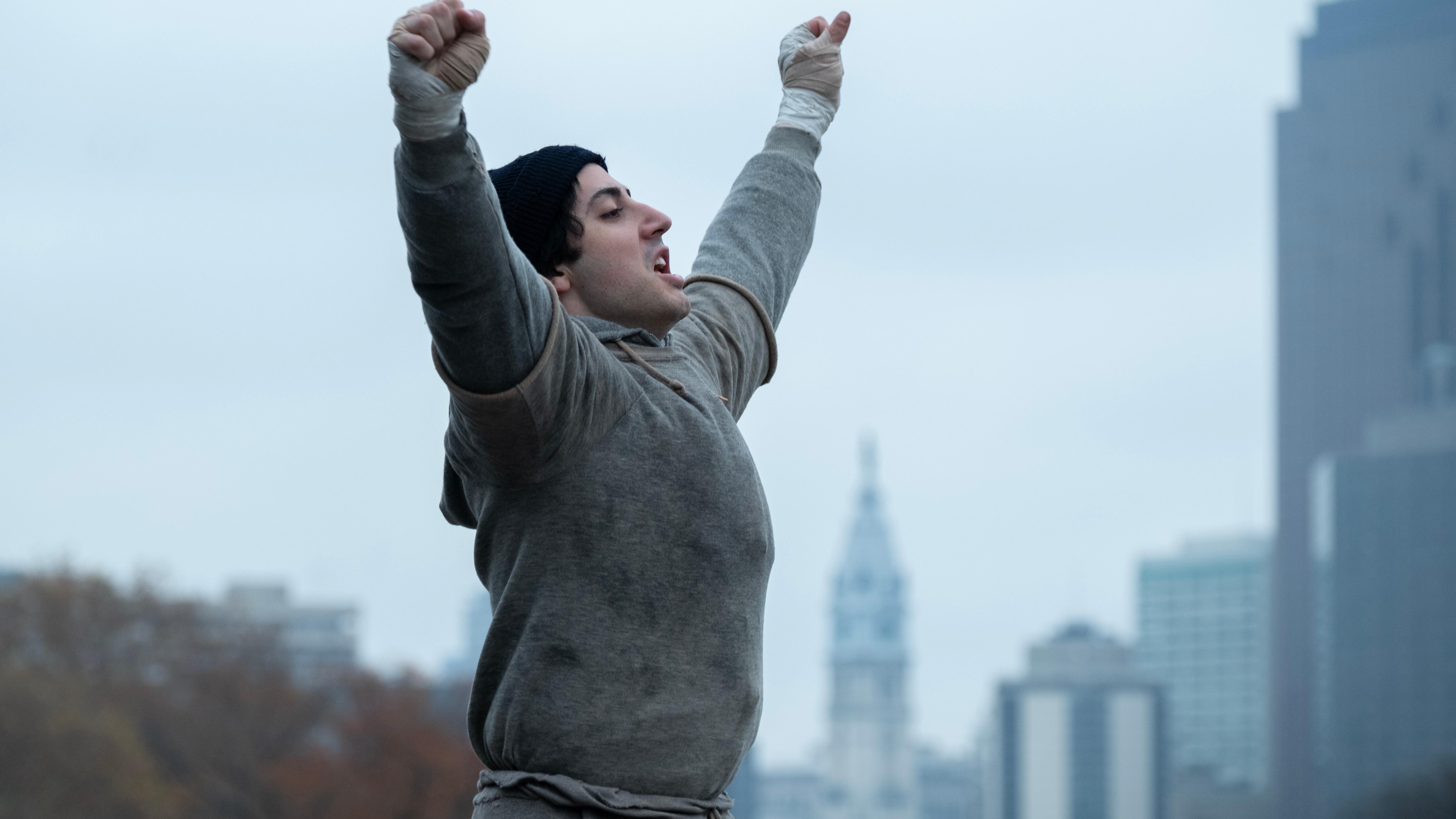
“It was the first truly inspirational movie I’d ever seen,” says Peter Farrelly about Rocky , the 1976 smash hit written by and starring Sylvester Stallone . The making of Rocky , which celebrates its 50th anniversary this fall, is the subject of the Oscar-winning Green Book director’s latest movie I Play Rocky . The film, written by Peter Gamble, traces the remarkable true story of how Sylvester Stallone bet on himself and won big. As the movie depicts, there were so many odds stacked against Rocky ever seeing the light of day, it’s basically a miracle that it ever did. Rocky is the ultimate underdog story, a film about achieving recognition and finally being seen for the thing you’ve spent your whole life trying to do. That theme resonated deeply with Gamble, who worked as a ghostwriter in Hollywood for decades, eager to finally have his work recognized as his own. Gamble was trying to make a name for himself, just like Stallone was trying to do with Rocky . His manager, John Zoazirny, encouraged him to write a biopic to get on the Black List, an annual survey of the best unproduced scripts. They were throwing ideas around, and Zoazirny suggested Stallone. Instantly, the name unlocked everything for Gamble. “As soon as he said it, I just felt it. I saw everything,” he says. “Stallone was unseen and felt he had something inside him. I so connected to that, and I felt like I had to write it.” Finding Rocky Anthony Ippolito in I Play Rocky Courtesy of Amazon MGM Studios But even a script that Farrelly calls the best he’s ever read could never work without a convincing Rocky. Farrelly and casting agent Rick Montgomery were planning to start a worldwide search to cast Stallone. That search never began. That’s because an upcoming actor, Anthony Ippolito, made a bold swing—not unlike the one Stallone made in betting on himself to play Rocky. After the trades announced that I Play Rocky was in development, Ippolito, in his grandmother’s basement, recorded himself doing scenes from the original Rocky , and sent the tape to Montgomery. The casting director was so impressed that he sent Ippolito the script for I Play Rocky and asked the actor to perform a few scenes from the film. He then sent that tape to Farrelly, who was blown away. “The search was over,” Farrelly says. “We didn’t find him; he found us.” “People have asked me what gave me the courage to take a chance on this guy. But I didn’t take a chance. He was fully formed,” says Farrelly. There was an element to his performance that impressed the filmmaker beyond how much he looked and sounded like Stallone: he understood the difference between Stallone and Rocky. “It’s a subtle difference, even though it’s played by the same person,” explains Farrelly. “Rocky’s a punch-drunk boxer, and Stallone’s a very intelligent guy who’s constantly trying to improve himself. He totally got that.” The real Sylvester Stallone did not have any official involvement in making I Play Rocky (though he gave the film his blessing), but Farrelly notes that he was sent Ippolito’s tape. Stallone played it for his daughters, who thought it was old footage of their dad. “Stallone said: ‘This kid didn’t impersonate me. He became me,’” recalls Farrelly. And just as Stallone became Rocky in 1976, Ippolito became Stallone in 2026. Farrelly won’t take any credit for shaping Ippolito’s performance. The only thing that was missing was Ippolito’s size. He was 145 pounds when he was cast, whereas Stallone was approximately 180 lbs. during the making of Rocky . “He was in the gym for a year and half. It was supposed to be six months, but the movie kept getting pushed back because of budget issues. Thank God, because it gave him enough time to put on 45 pounds of muscle,” says Farrelly. Ippolito, like Stallone, had never boxed. Nor had Stephan James, who plays Carl Weathers as Apollo Creed. “They came to me exactly the way the Rocky guys came,” says Farrelly. But after months of training at Gleason’s gym in Brooklyn, they were ready. Getting Rocky off the ground Peter Farrelly with Anthony Ippolito and Stephan James Courtesy of Amazon MGM Studios I Play Rocky closely follows the real story behind Rocky . The 2026 film opens with Stallone auditioning for the role of Thug Number 2. His only lead role had been in 1974’s The Lord of Flatbush (though in I Play Rocky , his role is made to seem smaller), which underperformed at the box office. The actor had struggled to succeed in movies after some bit parts here and there. In desperation, I Play Rocky shows him auditioning for softcore pornography films; this is true: Stallone starred in the 1970 film The Party at Kitty and Stud’s, which the company re-released after the success of Rocky as Italian Stallion , to take advantage of the actor’s newfound fame. Unable to avoid typecasting as petty criminals and with barely a dollar to his name, he’s pushed by his girlfriend Sasha (AnnaSophia Robb) to write a script and star in the movie himself. As in real life, the pair is depicted meeting at the movie theater they both worked at. Writing his own script is exactly what Stallone does. His work gets the attention of producers Irwin Winkler (P.J. Byrne) and Bob Chartoff (Toby Kebbell). One script in particular, about an underdog boxer, draws them in. Stallone had written the first draft of Rocky in three and a half days. Winkler and Chartoff can tell that Rocky had what it took to be a hit, but there’s one (major) problem: the studio (represented in I Play Rocky by executive Sandy Maddox, played by Tracy Letts) wants a proven actor, like Ryan O’Neal, Burt Reynolds, or Clint Eastwood, to play the lead. But Stallone is steadfast in his determination to play the role himself, constantly reminding the producers, “I play Rocky,” giving the new film its title. What followed was a tense, lengthy negotiation, which informed a significant amount of I Play Rocky . The producers regularly presented Stallone with an ever higher script fee, only to be routinely rejected. The offer steadily rose to an astonishing $360,000, an enormous amount for a script in the ‘70s, particularly for a struggling, out-of-work actor. “With people offering him all this money, one of the things he started to realize was he truly had something special,” says Gamble. “They would not have offered him $2 million in today’s money for [just] anything.” In writing the scenes, Gamble was struck by his own history in Hollywood, working as a ghostwriter. “One of the themes is being unseen. You’ve got this guy who writes Rocky , but what he’s really writing is his own story through the thin veneer of boxing. Everyone sees the script and they fall in love with it, yet they don’t realize that they’re falling in love with him. He’s got to show them that he’s the person that needs to be on screen,” explains Gamble. Making the movie on the cheap Ippolito as Stallone as Rocky in the meat-locker scene Courtesy of Amazon MGM Studios Eventually, Winkler and Chartoff found a potential loophole that could get the film made with Stallone in the lead. If they made it for under $1 million, they could cast Rocky themselves. Instead of $360,000, they offered Stallone around $35,000 for his script and his role in the film. Stallone giddily accepted, though he also negotiated that he’d make a cut of the profits if the film were to succeed like he believed it could. Stallone’s contract, one could argue, was set up for him to fail. The filming was scheduled for a mere 28 days, but if Stallone caused the production to fall behind by even one day, his contract stipulated that he could be replaced. That’s something Farrelly felt gave I Play Rocky significant dramatic heft. “The movie almost becomes An Officer and A Gentleman , with Lou Gossett Jr. breaking down Richard Gere. That element within Rocky turns it into something even better,” says Farrelly. Remarkably, Stallone had four hospital visits while filming Rocky —though because of budget constraints in I Play Rocky , the doctors came to him instead of using a hospital set. “He blew his leg out on day one, then had to go back another time for the same issue. Then he broke his hand punching the frozen meat, and the last was for the flu,” Farrelly says. In all four instances, Stallone left the hospital the same day, so the filming never fell behind. Farrelly puts it bluntly: “He got his ass kicked during the making of Rocky .” (Years later, while filming Rocky IV , Stallone was actually hospitalized after filming a fight with co-star Dolph Lundgren). Though some elements of the making of Stallone’s film in I Play Rocky may seem larger-than-life, Gamble drew all details from reality. “Everything I did, I tried to source at least two or three things,” says Gamble. The writer pulled from countless sources, including newspapers, magazines, radio and news interviews, documentaries and books to get a complete picture of the making of Rocky . Gamble came across various details that helped make the story richer and more accurate. “The fact that he calls himself Mike, and changes his name back to Sylvester—that’s an arc right there. Or that this was one of the very first movies to use Steadicam. These were just gifts, like manna from heaven,” Gamble says. When the film jumps into the making of Rocky , you’d be forgiven for doing a double take, as the scenes filmed in I Play Rocky look identical to the ‘76 film. Farrelly credits his entire crew, and especially director of photography Sean Porter and costume designer Amy Roth. “The way we’d do it is, we’d have a monitor on the left of Rocky , and a monitor of our film on the right, and we’d set up the shot,” says Farrelly. It was an attention to detail that includes moments only the most serious Rocky fanatics would ever catch. “Something I’m really proud of is that in the beginning of Rocky , you start on Jesus and pull back and he’s in the ring fighting. At some point, somebody threw a balled-up cup onto the ring, and it bounces. Well, we had a guy in the crew throw a cup at the exact moment and it bounces, too. When I see that cup, I’m thinking, ‘we crossed the T’s and dotted the I’s,’” says Farrelly. A complete success story Robb as Sasha and Ippolito as Sylvester at the test screening in I Play Rocky Courtesy of Amazon MGM Studios After filming Rocky , a key test screening would be the first insight into whether Stallone, Winkler, and Chartoff’s big gamble would pay off. In I Play Rocky , Stallone and company watch the film among a crowd of moviegoers, though he’s so anxious he can hardly bring himself to stay in his seat, much less look at the screen. That anxiety is actually rooted in an earlier test screening, not depicted in I Play Rocky , during which nearly three-quarters of the audience walked out in the first 20 minutes. It was bad enough that the studio considered pulling the film altogether. But the second test screening was different. It’s here that we finally see various scenes from Rocky , faithfully recreated in Farrelly’s film, including the detail with the bouncing cup. The screening was a success, but nobody could have guessed quite how impactful the movie would be. Audience members broke out in applause, stood up, and cheered throughout the showing. That test screening proved to be an accurate precursor. Rocky premiered in New York on Nov. 21, 1976, before a wide release on Dec 3, and ended up with a worldwide gross of $225 million, equivalent to more than $1 billion in today’s dollars. It was the highest grossing film of the year. Stallone earned approximately $2.5 million thanks to the film's box-office domination, and the movie spawned five sequels over the next three decades in addition to the later Creed spin-offs. But it wasn’t just financial success that adorned Rocky . The movie earned 10 Oscar nominations, and Stallone became the first person to be nominated for actor and screenplay since Orson Welles for Citizen Kane in 1941. It won best editing, best director, and best picture, the last of these going to Chartoff and Winkler, though Stallone joined them on stage to celebrate the little film that could—and did.