The Sun, Earth, and Jupiter could be trapping invisible dark matter
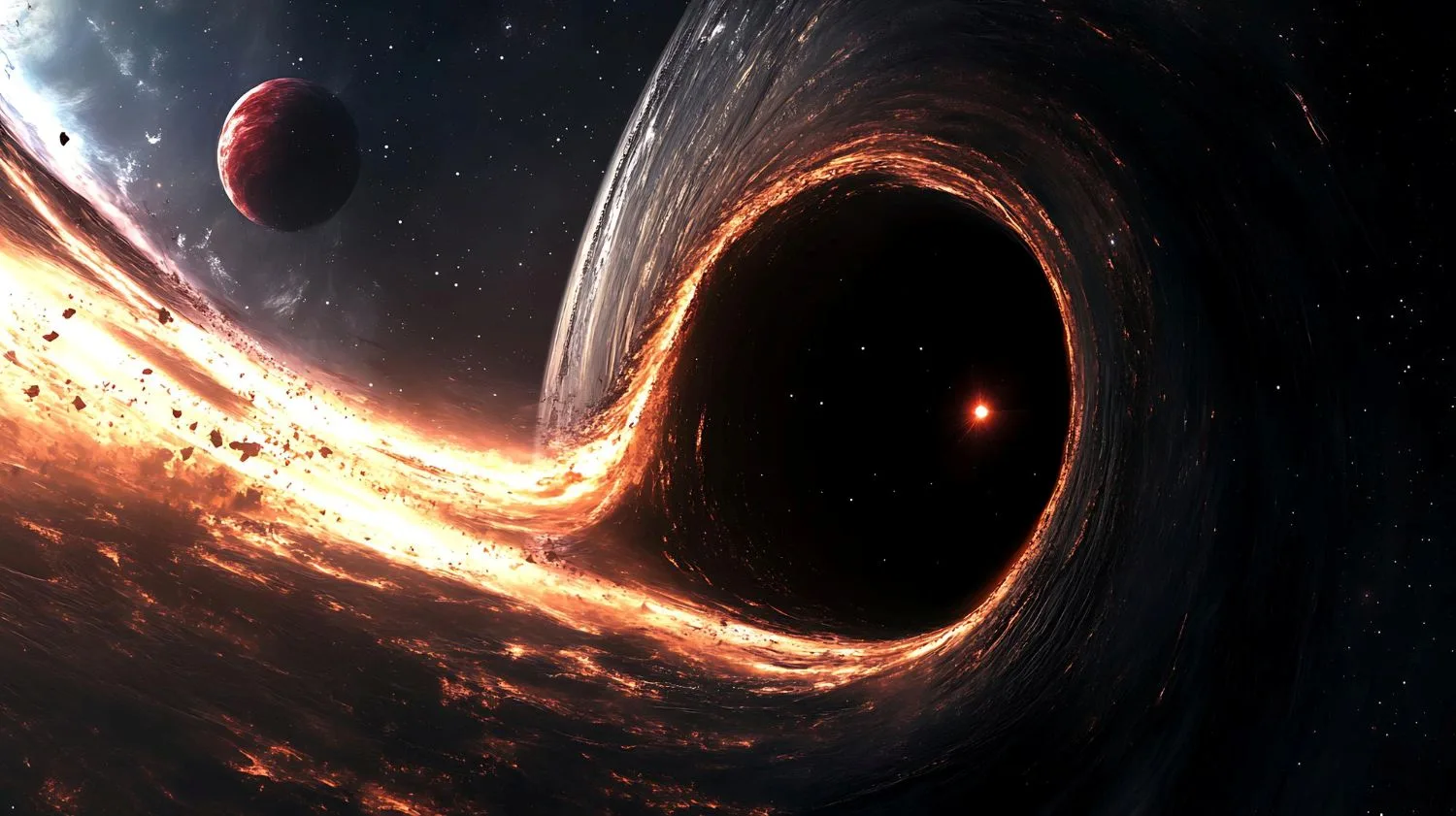
Despite making up roughly 85% of all matter in the universe, dark matter has never been directly detected. Most experiments search for faint signals produced when dark matter particles collide with ordinary matter, but if those particles move too slowly, they may transfer too little energy to trigger a detectable signal. The research team presented their new method for locating dark matter in a recent publication in the Journal of Cosmology and Astroparticle Physics . This team has suggested using planetary systems, stellar populations, and white dwarf stars as natural traps for dark matter. The researchers Alejandro Ibarra, Merlin Reichard, and Gaurav Tomar explored the possibility that dark matter particles can gather within celestial objects for billions of years and create detectable signs. Although the study did not find any evidence of dark matter , the research provides a way to eliminate some possible explanations and can help direct future research efforts. The idea relies on a simple principle. If dark matter possesses tiny electric or magnetic properties, it could occasionally interact with ordinary matter. Slow-moving dark matter particles might fail to produce measurable signals in laboratory detectors, but they would also be easier for a planet or star to capture gravitationally. As these particles pass through a celestial body, repeated collisions could cause them to lose energy. Eventually, they would become trapped by gravity and sink toward the object’s center. Gravity can exist without mass, researcher shows, for the first time Over time, vast numbers of particles could accumulate. If dark matter particles can annihilate when they meet one another, they could produce other particles or deposit energy into the surrounding environment. That process would leave observable clues. The researchers examined four types of objects: Earth, the Sun, Jupiter, and White dwarf stars. “In this work, we considered four celestial bodies: Earth, the Sun, Jupiter and white dwarfs,” said corresponding author Gaurav Tomar of the Center for Quantum Spacetime at Sogang University. Different objects provide different ways to search for dark matter. For Earth and the Sun, the team focused on neutrinos that could be produced when dark matter particles annihilate inside their interiors. Neutrinos can travel through enormous amounts of matter without being absorbed, allowing instruments such as IceCube in Antarctica to detect them potentially. The absence of the expected neutrino signals allowed the researchers to place limits on some dark matter models. For Jupiter and white dwarfs, the researchers examined heating. Unlike the Sun, these objects are not powered by ongoing nuclear fusion in the same way, making additional heat sources easier to identify. If dark matter accumulation would produce more heat than the object is actually observed to emit, that dark matter scenario can be rejected. This research did not find any indications that dark matter exists. The studies have eliminated some possible ranges for how much dark matter particles would weigh, as well as whether these particles could have an electric charge and/or electromagnetic properties. Earth proved particularly useful for constraining scenarios involving minuscule electric charges, while white dwarfs provided strong limits on other hypothetical dark matter interactions. There is an important caveat. The results depend heavily on estimates of how much dark matter exists around the objects being studied. For example, the researchers analyzed white dwarfs in the M4 globular cluster, where the dark matter density is not directly measured and must be estimated using models. “We do not know the dark matter density there,” Tomar noted. “We used estimated values, so if those values change, our limits could become weaker or stronger.” The researchers believe even better opportunities may exist elsewhere. Particularly promising targets include extremely cold white dwarfs, regions thought to contain dense concentrations of dark matter, and exoplanets beyond our solar system . In these environments, even a small amount of dark-matter-induced heating could stand out more clearly against the background temperature. Most dark matter searches focus on underground detectors, particle accelerators, or astronomical observations of galaxies. This study highlights another possibility: the universe may already contain billions of enormous dark matter detectors in the form of planets and stars. The recent study has reduced the number of possible explanations for what dark matter is. Future studies of white dwarf stars, exoplanets, and other objects in space may provide clues to solve the mystery of dark matter, which is one of the most perplexing questions in contemporary physics. Journal Reference: Celestial probes of dark matter electromagnetic interactions, Journal of Cosmology and Astroparticle Physics (2026). On arXiv: arxiv.org/abs/2608.27957