OPINION | Chinatown Tiaras and Billionaire Budgets: Miss South Africa's identity crisis
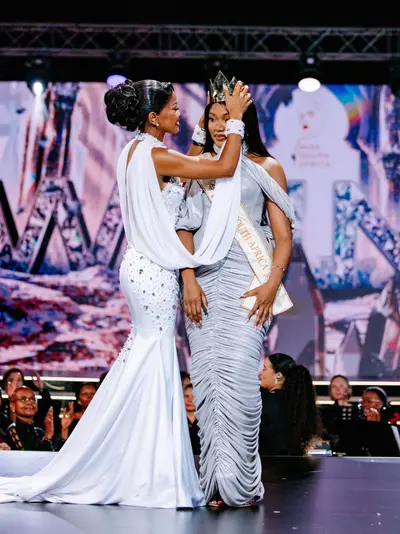
Miss South Africa, Tiyani Makamu being crowned. Picture: Supplied/Miss South Africa 2026. I have a childhood friend. Named Ncumisa. Beautiful. Ncumisa has a child. Named Paris. Beautiful too. Ncumisa and I have been having rather uncomfortable conversations about Paris's modelling career. She is preparing for the 2026 Miss Ace International pageant. The fundraising, logistics and financial demands have been strenuous on the parent. I, meanwhile, have been spectacularly unsympathetic. I simply cannot understand why a child must be introduced so early to an industry whose principal export appears to be increasingly unrealistic expectations of what a woman ought to look like and be. I do not particularly believe in beauty pageants. Or so I thought. This past Saturday, 14 November 2026, as I perambulated the Miss South Africa 2026 red carpet at the Sandton Convention Centre, I experienced a sudden epiphany. I was surrounded by extraordinarily radiant, confident women and men, some draped in their Miss Soweto, Miss Mpumalanga and Miss Everywhere-Else sashes. Crowns and all. Even pre-teen models were out there in full force. "I was surrounded by extraordinarily radiant, confident women and men, some draped in their Miss Soweto, Miss Mpumalanga and Miss Everywhere-Else sashes. Crowns and all." Picture: Supplied/Miss South Africa What struck me was not just the sheer abundance of pulchritude, but the extraordinary energy in the room. An almost palpable cocktail of excitement, anticipation and possibility. For those in attendance, the occasion carried a significance that went well beyond the spectacle itself. It was, in a very real sense, an opportunity to see their dreams take tangible form; to witness, perhaps, a glimpse of the world they had imagined and aspired to inhabit. People paid between R450 and R600 per ticket, while others enjoyed the more exclusive hospitality packages or had secured invitations. Former Miss South Africa Shudufhadzo Musida and her (speculated) putative paramour, Masego 'Maps' Maponyane, appeared quite inseparable throughout the proceedings. I also caught sight of another former Miss South Africa, Basetsana Kumalo (née Makgalamele), who was the very picture of elegance in person. For me, the spectators in the foyer and on the red carpet were far better dressed and infinitely beautifuller (my English teacher would cringe) than the actual contestants on stage. And I am not throwing shade. So much beauty in one venue should be classified as an illegal gathering. Former Miss South Africa Shudufhadzo Musida Picture: Miss South Africa/Supplied Masego 'Maps' Maponyane. Picture: Miss South Africa/Supplied Which brings me squarely to the vexed question of beauty itself. If you've ventured online and sampled the commentary on this year's Miss South Africa pageant, you'll know the verdict has been decidedly unkind. By all accounts, the institution has suffered something of an aesthetic and reputational implosion. It has, quite frankly, gone to the dogs! Read this last line in a Karen's voice. Still on the subject of beauty, make-up has always been a particular point of contention for me. I struggle to appreciate manufactured, contoured and powdered beauty, particularly at so-called beauty pageants. But, I won't say this. To my mind, it is no different from an athlete entering the Olympics pumped full of anabolic-androgenic steroids, only to be crowned the finest athlete. What, precisely, is being celebrated? "For generations, Miss South Africa has been more than a beauty pageant. It has been a platform celebrating the aspirations, achievements and potential of South African women," was the official position of the organisers. Great. Now if this is the new rubric, why not simply call it Miss Personality South Africa? Calling it Miss South Africa simply primes a simple mind like mine to think of physical beauty first . "On the judging process, we recognise that South Africans hold diverse views about the qualities that should define Miss South Africa. Beauty, elegance, confidence and presence remain fundamental to the competition . However, we equally are equally resolute in our belief that the title must reflect the evolving aspirations and realities of South African society." If I am reading this correctly, the implication is that as a society's aesthetic diversity expands, the definition of beauty must become sufficiently elastic to accommodate everyone. Where conventional physical attributes may fall short, we simply introduce alternative assessment criteria to compensate. Dr Precious Motsepe robes Tiyani Makamu. Picture: Miss South Africa/Supplied Put simply, if beauty cannot be established on its own merits, perhaps confidence, charisma and a compelling personal narrative can be recruited? No? Yes. That is exactly what is happening with these pageants now. Sizakuba noonobuhle abengekho bahle tu. Nathi sakusineka sivume sithi “hay’ mhle shem...” nangona sibona ukuba umntu lo ungxoliswe kanobom'. "Beyond her physical presence, today's Miss South Africa must demonstrate intelligence, leadership, authenticity, compassion, strong communication skills and genuine commitment to making a meaningful difference." Again, just call this affair Miss Personality South Africa. Easy peasy. I genuinely feel for our newly crowned Miss South Africa, Tiyani Makamu. She is undeniably intelligent and has the potential to inject considerable value into female entrepreneurship through her Hubsela venture and the opportunities this title will afford her. I don't recall seeing much of a smile, let alone any unrestrained jubilation, as she was crowned. Then again, I may have been somewhat too preoccupied with Patrice Motsepe's Hidden Valley Hidden Secret red wine to have registered every nuance of what was unfolding on stage. An extraordinary wine, that Hidden Secret! One wonders whether Makamu, too, recognised that she was participating in a rather hastily assembled and poorly executed iteration of what was once a premier national institution. It pains me to say this because the production reflects rather poorly on the new licence holders, the Motsepe Group, operating under Dr Precious Moloi-Motsepe's House of Nala. There is an uncomfortable reputational dimension to all this. Whenever a major institution or production underperforms under black leadership, it risks reinforcing the pernicious and deeply entrenched stereotype that black-led enterprises are synonymous with incompetence. Which is always an unfair generalisation, but it is precisely why standards, execution and institutional accountability matter so much. Black excellence cannot merely be invoked as a slogan; it must be demonstrable in the quality of the work. Having attended several Motsepe-affiliated events, I am particularly baffled by what appears to be a recurring problem of under-delivery. Surely, with the financial muscle available to this group, one should expect considerably more polished productions? And perhaps the problem is not necessarily a lack of money or even leadership at the top. It may well be a question of operational competence further down the organisational hierarchy. Underperforming executives, inefficient procurement, poor project management, and so forth... A substantial budget means very little if the people entrusted with executing the vision cannot deliver. Somewhere between the boardroom and the ballroom, something is going terribly wrong. Whether that is incompetence, mismanagement or the proverbial middlemen cutting corners is a question worth asking. Aside: How much did the Motsepe Group pay Stephanie Weil’s Weil Entertainment to take ownership of this pageant? These corporate handovers matter because institutional magic gets lost in translation. Sponsors vanish, partners scatter, and suddenly we are staring at what looks like a Chinatown tiara, dubbed a temporary Imbokodo, where Nungu Diamonds’ breathtaking bespoke crowns used to sit. Gone are the plush suburban apartments and Mercedes-Benzes for the winners. Instead, a 27-year-old Tiyani Makamu walks away with R1 million in cold hard cash. Runner-up Cwenga Koyana Kotu-Rammopo pockets R250 000 in filthy lucre, while third-placed Lesego Khumo Nyathela takes a paltry R150 000. Even the remaining nine finalists receive R25 000 cash each. Here is a competition that insists that it is celebrating intelligence, confidence and leadership, yet it somehow reduces its very own rewards to the transactional logic of capitalism. Everything is monetary compensation. EFTs where there could have been experiences. Why not offer international travel, educational fellowships abroad or culturally immersive experiences that expand intellectual horizons and fundamentally alter how these young women see the world? There is something pedestrian about reducing human potential to a succession of bank transfers. That said, had I been one of the judges these would've been the outcomes: Makhosazana Azana Masango would've won. Followed by Palesa Van Rooyen and then a tie for third place between Alia Khan Koumantarakis and Cwenga Koyana Kotu-Rammopo. But then again, I was not on the judging panel. And frankly, neither should've Advocate Thuli Madonsela or Medical Doctor Musa Mthombeni. Dr Precious Motsepe, Medical Doctor Musa Mthombeni and Advocate Thuli Madonsela. Picture: Miss South Africa/Supplied At this rate, I wouldn’t be surprised if an archaeologist made it onto the judging panel next year and asked contestants stuff like “how do you reconcile the preservation of historically contingent aesthetic ideals with the deconstruction of inherited sociocultural beauty hierarchies?” I kid you not. This is coming! Watch. That said, there is actually a silver lining to all of this. Miss South Africa is firmly back in the cultural zeitgeist. In fact, I urge fellow South Africans to attend more pageants and rally behind rising hopefuls like the young Paris Mangqalazas of this world. Surrounding ourselves with beauty and pageantry is a potent antidote to the daily diet of crime, corruption, and bloodshed dominating our headlines. It makes us a beautifuller nation. Imagine a world with no Brown Mogotsis nor any feral Matlalas... Thank you to the organisers of Miss South Africa for inadvertently reminding us that aesthetics still matter. Beauty exists. Let us not shift goal posts for aesthetic diversities which should have their own clearly defined categories... In closing, with the Motsepe Group's billions behind the Miss South Africa pageant, I am confident that things can only get better from here, and that next year will see a remarkable turnaround. Until then, Godspeed. * Unathi Kondile is a retired newspaperman and the Founding Editor of Independent Media's I'solezwe lesiXhosa. ** The views expressed do not necessarily reflect the views of the National Media Group.