Mars Sample Return: NASA’s new effort to bring samples home
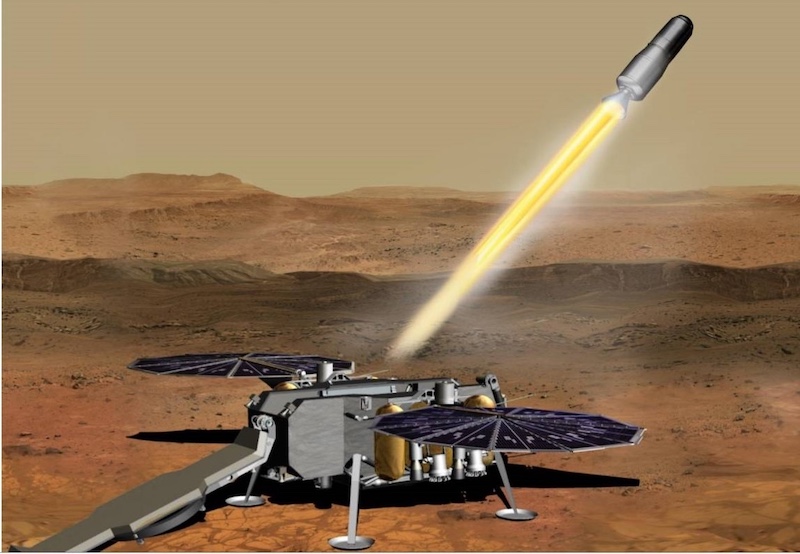
View larger . | Artist’s concept of the Mars Ascent Vehicle taking off from Mars in the former Mars Sample Return concept. Scientists are eager to have the samples that the Perseverance rover has collected brought back to Earth. Image via NASA / JPL-Caltech. Mars Sample Return is NASA’s plan to bring samples of Martian rocks and sand back to Earth. Scientists would then study the samples in labs for clues to the planet’s wet past and possible signs of microbial life. NASA just proposed a new strategy to bring those samples home. Will it work? Previous proposals were deemed to be too expensive and the timeframe to bring the samples back to Earth was too long. Are you a moon-watcher? Then you’ll love EarthSky’s 2027 lunar calendar! Order yours today . Mars Sample Return still alive? The Mars Sample Return concept was scrapped — and declared dead — due to ballooning costs and a too-long timeframe. But the Mars Perseverance rover has already collected samples. It’s possible they contain evidence of ancient microbial life on Mars. So scientists are itching to have the samples returned to Earth. And now NASA has announced a new plan. Tiffany Morgan , director of the Mars Exploration Program , detailed NASA’s new Perseverance Sample Retrieval Architecture on November 9, 2026, during a virtual meeting of the Mars Exploration Program Analysis Group . The new retrieval architecture provides a framework that NASA could build the actual mission upon. The idea now is to develop “impartial recommendations” for the mission. For example, the architecture will cover proposed mission requirements, review previous lessons learned and evaluate current capabilities and acquisition options. There will also be a Perseverance Sample Retrieval Architecture strategy team kickoff in January 2027. A final report will be due in winter 2027-2028. Leonard David wrote about the new concept for Space.com and Leonard David’s INSIDE OUTER SPACE on November 10, 2026. A new strategy for Mars Sample Return The framework of the new strategy is as follows: Develop impartial recommendations for retrieving the Martian samples collected by NASA’s Perseverance Mars rover and deliver them to Earth Assess proposed mission requirements Review prior lessons learned Evaluate current capabilities and acquisition options A previous proposal would have cost an estimated $11 billion by 2024. And the samples wouldn’t have been returned to Earth until 2040. NASA determined that was too long and too expensive. Another effort would cost $8 billion, with a return to Earth by 2035. View larger . | Some of the samples, in small tubes, that Perseverance has collected over the years. Image via NASA . Perseverance rover’s priceless samples The Perseverance rover has obtained numerous samples from Martian rocks. They are stored in small tubes. Some tubes are kept within the rover for analysis and others are left on the ground, waiting — hopefully — to be picked up later in a sample return mission. The rover had collected 33 samples by 2025. Meanwhile, Perseverance is still exploring a region just outside the rim of Jezero crater. It still has a few sample tubes left, but not too many. Signs of ancient life? One of the most important — and exciting — samples comes from a rock called Cheyava Falls. It lies in an ancient riverbed that dried up billions of years ago. Perseverance found odd rings and dots on the rock that looked like leopard spots and poppy seeds. They highly resembled formations on rocks on Earth created by microbes. Could they be signs of ancient life? The rover itself can’t determine for sure their origins, however. The samples need to be studied in more advanced labs on Earth. This is the primary reason these samples are so important. They could hold evidence of ancient microbial life. And we can’t bring them home yet. View larger/full image . | Perseverance captured this view of the “leopard spots” (rings) and “poppy seeds” (smaller dots) on a Martian mudstone rock. Continued analysis of the rover data supports the possibility that the formations involved living microorganisms. It’s a compelling — though still inconclusive — case for ancient life on Mars. Image via NASA / JPL-Caltech/ MSSS. Risks for future human missions There is another element to the sample return quest as well. It involves the risks to future human astronauts landing on Mars. There could be compounds in the samples or other rocks or sand that are toxic and dangerous to humans. Bruce Jakosky of the University of Colorado Boulder and the University of Washington told Space.com: The purpose is to understand the risk to astronauts and to hardware. The risk includes that from compounds that are present in the soil that are hazardous to astronauts if breathed in. This includes perchlorates and chloromethanes that have been identified already, and detection of other species that might be present. It also includes dust that can be breathed in by astronauts and that can affect hardware wear and tear. View larger . | An astronaut examines rocks on Mars in this artist’s concept. Toxic compounds in the rocks or sand could pose a risk to future astronauts. The new sample return strategy calls for the samples from the Perseverance rover to be returned to Earth for study before any human missions begin. Image via NASA/ Wikimedia Commons . Mars Sample Return 1st, then astronauts Jakosky explained why it’s important to bring the samples back to Earth before human missions to Mars. This includes astronaut safety as a top priority: Identify and characterize known hazardous chemicals to ensure astronaut safety (e.g., perchlorates and chloromethanes), and look for possible additional hazardous chemicals Characterize very fine dust particles that could cause respiratory issues in astronauts Characterize dust and regolith properties for spacesuit design and wear patterns Search in advance of the arrival of humans for evidence of extant life that could interact with terrestrial life Enhance astronaut effectiveness on the surface and science return from human missions by providing initial context and analysis Demonstrate successful round-trip to Mars Demonstrate successful round-trip travel, including entry, descent, landing and ascent from the surface of Mars. Demonstrate implementation of planetary protection protocols. While human missions would not use the same approaches, what we learn from doing these would make the approach for humans much easier to plan and implement. China’s sample return mission Meanwhile, China is pushing ahead with its own sample return mission. The complex Tianwen-3 mission will have a lander, an ascender, a service capsule, an orbiter and an Earth reentry module. China is looking to launch the mission by 2028 and bring the samples back to Earth by 2031. Bottom line: NASA has begun a new effort for a Mars Sample Return mission to bring the highly-sought samples from the Perseverance rover back to Earth. Via Space.com Via Leonard David’s INSIDE OUTER SPACE Read more: Life on Mars? Odd rings and spots tantalize scientists Read more: Ancient life on Mars? Rover finds intriguing ‘leopard spots’ Paul Scott Anderson View Articles About the Author: Paul Scott Anderson has had a passion for space exploration that began when he was a child when he watched Carl Sagan’s Cosmos. He studied English, writing, art and computer/publication design in high school and college. He later started his blog The Meridiani Journal in 2005, which was later renamed Planetaria. He also later started the blog Fermi Paradoxica, about the search for life elsewhere in the universe. While interested in all aspects of space exploration, his primary passion is planetary science and SETI. In 2011, he started writing about space on a freelance basis with Universe Today. He has also written for SpaceFlight Insider and AmericaSpace and has also been published in The Mars Quarterly. He also did some supplementary writing for the iOS app Exoplanet. He has been writing for EarthSky since 2018, and also assists with proofing and social media.