How Ukraine’s Flamingo missiles are taking the fight to Putin as Kyiv cripples Crimea Bridge
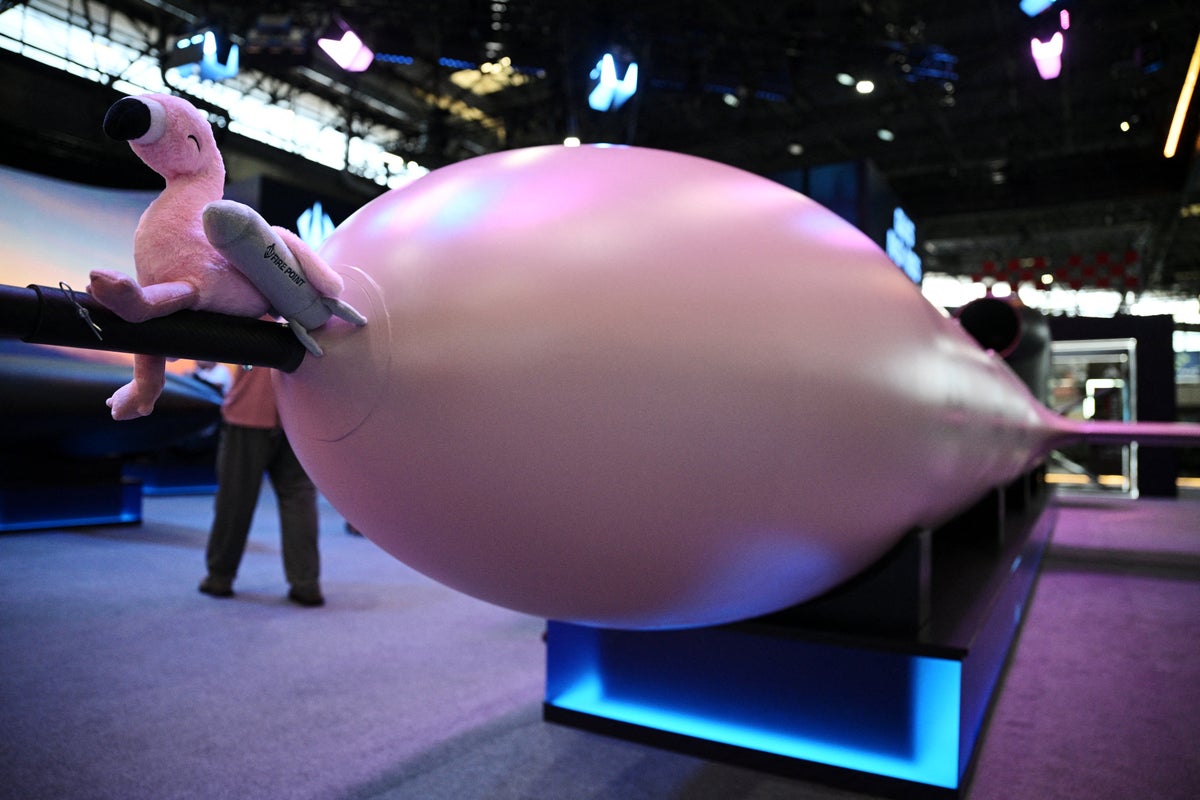
When Volodymyr Zelensky celebrated a second strike in 24 hours on the Russian-built Crimea bridge , he hailed the Flamingo cruise missile for carrying out the “precision-guided strike” at a key moment. Footage shared by Ukraine’s president on social media showed the moment a missile soared towards the bridge, seconds before it cut out due to issues with the communications uplink. The bridge strike was the result of a multiple stage operation carried out over several weeks, he said. “Today, at the key stage, the ‘Palianytsia’ drones performed exceptionally well, striking the road section of the bridge, while ‘Neptune’ missiles, ‘Ruta’ drones, and FP-5 drones struck the railway section. “Using ‘Flamingo,’ our warriors carried out a precision-guided strike – and the communications uplink worked flawlessly until the very last seconds.” As Ukraine has intensified its strikes on Russia , the Flamingo has become a vital part of the country’s growing artillery as a long-range cruise missile. Anton Gerashchenko shared footage on social media of a Ukrainian FP-5 Flamingo cruise missile seconds before striking the Kerch Bridge (Pravda Gerashchenko) What is the Flamingo missile? The missile was unveiled last August as a cruise missile with a range of 3,000km, a maximum speed of 900kmph and a payload of over a tonne. It has since been used in strikes deep into Russian territory . The FP-5 “Flamingo” missile is powered by a rocket and a Soviet-era turbofan jet engine bolted on top. Some of those engines have been dug out of landfill dumps. It’s got twice the range of the US Tomahawk, carries twice as much explosive and costs about the same. Fire Point Technology has described its missile as a “modern ground-launched unmanned aerial vehicle/cruise missile system” which works day or night, even under conditions of active electronic countermeasures. The firm said: “’Flamingo’ stands out for its ease of use and low cost. It is the largest system in its class, yet it remains simple to manufacture and operate. “No expensive launch platforms are required—the launchers are reusable, making deployment more cost-effective. During transport, the FP-5 can be disguised as an ordinary truck, providing an additional level of operational security, as the system does not resemble a weapon from the outside.” The Flamingo is an entirely Ukrainian-made long-range missile (AP) Where can the missile be used? One of its main advantages is that it is entirely under the control of Ukraine’s forces. Historically Ukraine’s allies have at points restricted use of their missiles. The UK and France restricted the use of the Anglo-French Storm Shadow cruise missiles in 2024, while the US quietly blocked use of American ATACM missiles against Russian targets in Russia last year, and held off on directly giving Tomahawk missiles to Ukraine. In contrast, Kyiv can fire the Flamingo at any target it wants. It is not restricted by what Ukraine’s “allies” say it can and cannot do when fighting Russia’s invading forces. Prototypes were painted pink to make them easier to retrieve from test flights. They strike deep inside Russia and are designed to destroy Moscow’s capacity to wage war in Ukraine. “When you have a gun being pointed towards your head, you don’t think about standards, you think that ‘this should be working’,” says Iyna Terekh, the chief technology officer of Fire Point, which makes Flamingos among other munitions. “And the huge achievement of the Ukrainian government is to downgrade the bureaucracy pressure as much as possible so that technology can thrive. “And that is what happened to our company. We didn’t care that we meet Nato standards. “We only cared that our weapons would be effective on the front line, not on some paperwork. We could, as a result, make a very effective weapon.” Launch of a long-range ‘Flamingo’ missile, which Kyiv can use without any restrictions (ZN.UA) Where has the Flamingo been used? As well as the Crimean Bridge attack, the Flamingo has played a crucial role in a number of operations. Flamingos were one of many systems deployed in a long-range attack on key oil industry facilities near Moscow in September. Flamingo missiles were used in deep strikes in the Samara region back in August, attacking Russia’s Progress Center where electronics production took place. President Zelensky spoke of using the FP-5 Flamingos to strike the Titan-Barrikady facility in Volgograd in June, which he described as “a major industrial complex where the enemy produces artillery systems and specialized military equipment, including components for missile launch systems used in attacks against our people.” The missile was deployed in May as part of the Ukrainian armed forces’ Deep Strike operation against several enemy targets, including military-industrial complex facilities in Cheboksary.