Amazon Alexa Tablet 8 review – This dirt-cheap Android tablet in mini format is really unique
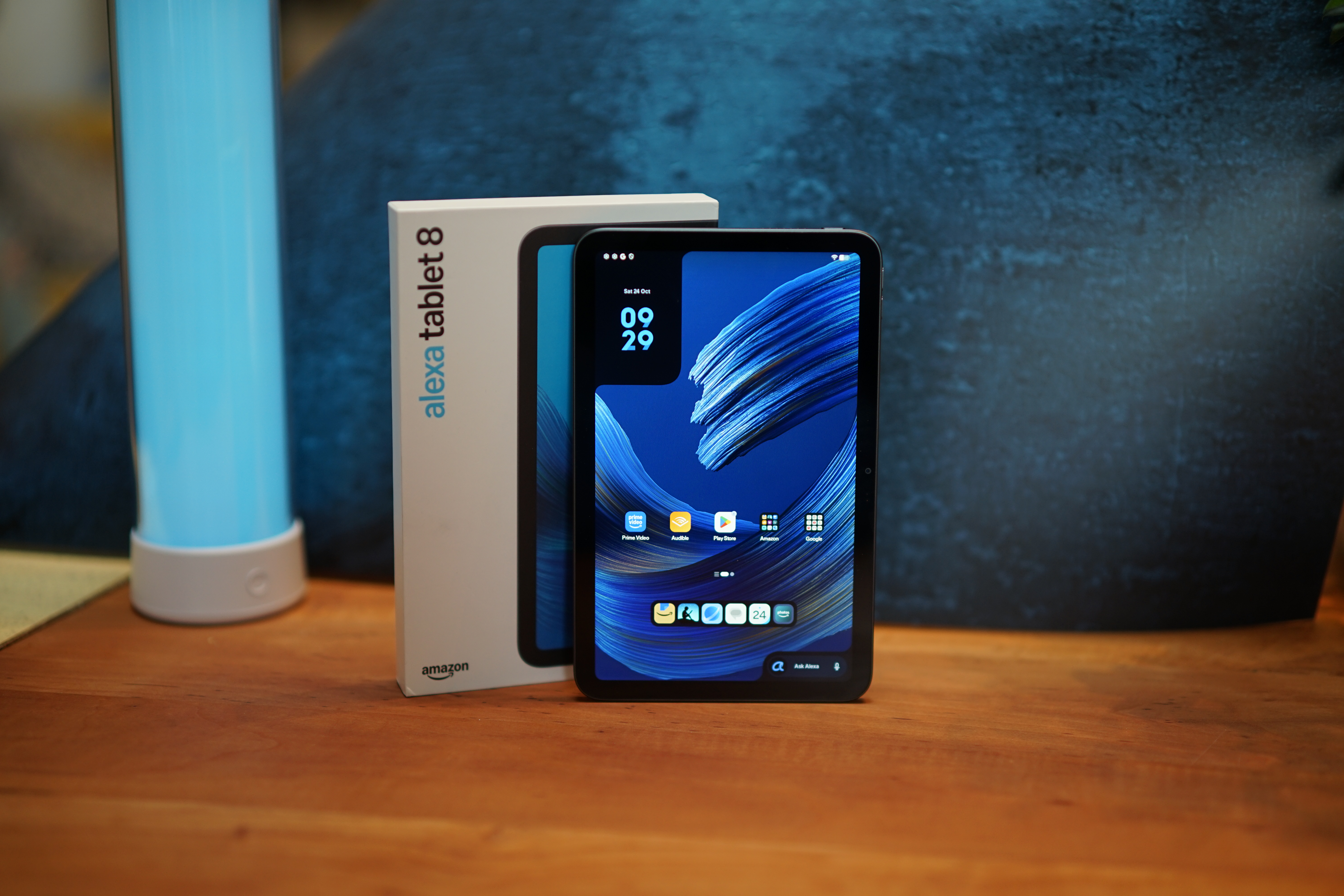
While with Amazon's earlier Fire tablets you had to accept many software limitations, the Alexa tablets want to be better. And indeed you can use the tablet without signing in to Amazon and you now also have access to the Google Play Store and alternative stores to install apps. The chassis feels surprisingly high quality despite the affordable price; as for performance, you should not expect too much: stuttering and waiting times are part of daily life on the Alexa Tablet 8. The battery is also not very large, but it can last through the day with normal use. Ads are displayed on the lock screen, which can be disabled for an additional fee. Only with an Amazon account can you use the features of the pre-installed AI Alexa+. For that, after an as-yet undefined Early Access phase you will also need an Amazon Prime subscription or an independent subscription. You are no longer as tightly bound to the Amazon ecosystem with the Alexa tablets, and you can use them like a regular Android tablet without signing in to Amazon. For little money there is a decent tablet with a great aluminum chassis; you should not expect too much performance or features. Pros + low price + high-quality, sturdy aluminum chassis + Android 16 with Play Store + usable without signing in to Amazon + bright display with no PWM + low heat under load Cons - low performance, stuttering - removal of ads for an additional fee - tight storage - no microSD reader - low display resolution, mediocre color rendering - weak cameras - speakers with low max volume - only passable battery life - no cellular, GPS or biometrics - Alexa+ will require a paid subscription later The Amazon Alexa Tablet 8 is available with or without ads. It costs from US$ 229, directly at amazon.com . If you would like to get rid of the ads on the lockscreen after the purchase, you will have to pay an additional fee. This is possible in the Amazon Account settings. $149.99 price as of 2026-11-17 11:31 UTC. Amazon Alexa Tablet 8 (all-new), 4GB RAM, 64GB, 8.7′′ compact tablet with vivid display, All-day battery, With Google Play, Designed for Alexa+, Graphite Table of Contents Verdict on the Amazon Alexa Tablet 8 Specifications Case and features – Amazon tablet brings a great alloy chassis Communication and operation – Amazon device without fingerprint sensor Software and sustainability – There are still ads Cameras – Only for emergency use Display – Amazon tablet with low resolution Performance, emissions, and battery life – Affordable Amazon tablet with limited power Notebookcheck overall rating Possible alternatives in comparison Processor Graphics adapter Memory 4 GB Display 8.70 inch 15:9, 1340 x 800 pixel 179 PPI, capacitive touchscreen, IPS, glossy: yes, 90 Hz Storage 64 GB eMMC Flash, 64 GB , 50 GB free Connections 1 USB 2.0, USB-C Power Delivery (PD), Brightness Sensor, Sensors: Acceleration Networking 802.11 a/b/g/n/ac/ax (a/b/g/n = Wi-Fi 4/ac = Wi-Fi 5/ax = Wi-Fi 6/), Bluetooth 5.3 Size height x width x depth (in mm): 8 x 208.9 x 132.6 ( = 0.31 x 8.22 x 5.22 in) Battery 4600 mAh Lithium-Polymer, 18 Watt charging Charging fast charging / Quickcharge Operating System Android 16 Camera Primary Camera: 8 MPix Secondary Camera: 5 MPix Additional features Speakers: stereo speakers, USB C cable, 24 Months Warranty, IP52 certified, fanless Weight 329 g ( = 11.61 oz / 0.73 pounds) Price 230 Euro Amazon Links Note: The manufacturer may use components from different suppliers including display panels, drives or memory sticks with similar specifications. The chassis looks very premium for such an affordable tablet: It consists of a seamless aluminum back cover, and the transitions to the screen cannot be felt by the touch. The tablet can only be slightly twisted; creaks can only be provoked at a few spots. The tablet is available in three color variants: Rose, turquoise blue, or a restrained blue-gray named Graphite. The Alexa Tablet is not as thin as other mini-tablets, but it weighs about the same. The screen bezels are a bit thick, which at first glance makes the tablet look less modern. You have no wired display output; instead there is only a slow standard USB port for data transfer. Memory is also limited: 4 GB RAM is tight; with storage you have a choice between 64 GB eMMC and 128 GB UFS-3.1 flash. There is no microSD slot. Amazon Alexa Tablet 8 Xiaomi Pad Mini Xiaomi Redmi K Pad Oppo Pad Mini DIN A5 ❌ 208.9 mm / 8.22 in 132.6 mm / 5.22 in 8 mm / 0.315 in 329 g0.725 lbs205.13 mm / 8.08 in 132.03 mm / 5.2 in 6.46 mm / 0.2543 in 326 g0.719 lbs205.13 mm / 8.08 in 132.03 mm / 5.2 in 6.46 mm / 0.2543 in 326 g0.719 lbs194.4 mm / 7.65 in 132.4 mm / 5.21 in 5.4 mm / 0.2126 in 279 g0.615 lbs210 mm / 8.27 in 148 mm / 5.83 in 1 mm / 0.03937 in 2.9 g0.00639 lbs WiFi 6 is the fastest supported Wi‐Fi standard. The Amazon Alexa Tablet thus only operates on the 2.4 or 5 GHz bands and reaches speeds around 400 MBit/s. This is typical for the price class and usually sufficient for everyday use. If you pay a bit more, you can get significantly faster Wi‐Fi in other mini tablets. There is no cellular variant, nor the ability to locate the tablet via satellites. Biometric security systems are completely absent; neither fingerprint nor facial recognition are available. The touchscreen can be operated quite reliably, but from time to time it can stutter. It is also quite prone to fingerprints, so you have to clean it frequently. Networking Amazon Alexa Tablet 8 802.11 a/b/g/n/ac/ax iperf3 transmit Wi-Fi6/7 RT-BE96U 379 (min: 301) MBit/s ∼24% iperf3 receive Wi-Fi6/7 RT-BE96U 407 (min: 375) MBit/s ∼23% Xiaomi Pad Mini 802.11 a/b/g/n/ac/ax/be iperf3 transmit AXE11000 983 (min: 922) MBit/s ∼100% iperf3 receive AXE11000 919 (min: 776) MBit/s ∼55% Oppo Pad Mini 802.11 a/b/g/n/ac/ax/be iperf3 transmit AXE11000 6GHz 1517 (min: 1282) MBit/s ∼100% iperf3 receive AXE11000 6GHz 1900 (min: 1797) MBit/s ∼100% Xiaomi Redmi K Pad 802.11 a/b/g/n/ac/ax/be iperf3 transmit AXE11000 867 (min: 734) MBit/s ∼88% iperf3 receive AXE11000 1657 (min: 1343) MBit/s ∼100% Average 802.11 a/b/g/n/ac/ax iperf3 transmit AXE11000 823 (min: 214) MBit/s ∼84% iperf3 receive AXE11000 825 (min: 234) MBit/s ∼50% iperf3 transmit AXE11000 6GHz 1161 (min: 417) MBit/s ∼77% iperf3 receive AXE11000 6GHz 1230 (min: 743) MBit/s ∼65% iperf3 transmit Wi-Fi6/7 RT-BE96U 464 (min: 324) MBit/s ∼29% iperf3 receive Wi-Fi6/7 RT-BE96U 480 (min: 395) MBit/s ∼27% Average of class Tablet iperf3 transmit AXE11000 608 (min: 35.7) MBit/s ∼62% iperf3 receive AXE11000 760 (min: 120) MBit/s ∼46% iperf3 transmit AXE11000 6GHz 1280 (min: 330) MBit/s ∼84% iperf3 receive AXE11000 6GHz 1504 (min: 291) MBit/s ∼79% iperf3 transmit Wi-Fi6/7 RT-BE96U 1594 (min: 304) MBit/s ∼100% iperf3 receive Wi-Fi6/7 RT-BE96U 1808 (min: 353) MBit/s ∼100% Amazon is no longer relying on a closed system for the first time, instead using conventional Android 16 with adjustments. The Google Play Store is now installed by default, and there is no longer a dedicated Amazon App Store. Of course all Amazon apps are pre-installed, such as Kindle, Luna, Music, or Prime Video; these can be deactivated but not completely deleted. A subscription for the built-in Amazon AI Alexa+ is included with the purchase, later it will also require its own subscription or Amazon Prime. Regarding sustainability, Amazon states that 8% of materials and 44% of aluminum are recycled. You can have the device recycled for free by Amazon after its life. How long updates will be provided, we have asked the manufacturer; as soon as we have information, we will report it. Front camera recording The cameras on the Alexa Tablet 8 are suitable only for emergencies in everyday use; the photos show little detail, overexpose, and generally appear somewhat blurry. Image comparison Choose a scene and navigate within the first image. One click changes the position on touchscreens. One click on the zoomed-in image opens the original in a new window. The first image shows the scaled photograph of the test device. Plant Surrounding Low Light click to load images 4.8 ∆E 7.1 ∆E 11.5 ∆E 4.3 ∆E 9.5 ∆E 5.1 ∆E 5.1 ∆E 9.6 ∆E 7.6 ∆E 3.7 ∆E 6.7 ∆E 5 ∆E 5.1 ∆E 7.7 ∆E 7.7 ∆E 4 ∆E 7.2 ∆E 8.2 ∆E 7.1 ∆E 6.9 ∆E 10.2 ∆E 6.5 ∆E 4.6 ∆E 8.5 ∆E ColorChecker Amazon Alexa Tablet 8 : 6.82 ∆E min: 3.66 - max: 11.51 ∆E 30 ∆E 55.1 ∆E 40.2 ∆E 35.3 ∆E 45.6 ∆E 62.4 ∆E 53.7 ∆E 36.5 ∆E 44.2 ∆E 29.4 ∆E 65.1 ∆E 64.1 ∆E 31.9 ∆E 48.1 ∆E 38.2 ∆E 76.8 ∆E 44.6 ∆E 42.5 ∆E 94.3 ∆E 71.4 ∆E 52.5 ∆E 37.5 ∆E 24.4 ∆E 13.9 ∆E ColorChecker Amazon Alexa Tablet 8 : 47.4 ∆E min: 13.91 - max: 94.33 ∆E The tablet offers a relatively low-resolution screen with 1340 x 800 pixels. The 8.7-inch display isn't large, so the rendering doesn't look too washed out. Nevertheless, in direct comparison you can see a clear quality difference to higher-resolution screens. We measure 561 cd/m2 as maximum brightness with the brightness sensor enabled; in HDR mode and on small areas it can be even higher. This is well above Amazon's official claim of 400 cd/m2. The color rendering is only acceptable, a slight blue cast is visible to the naked eye. We do not observe PWM flicker. 561 cd/m2 Distribution of brightness tested with X-Rite i1Pro 3 Maximum: 561 cd/m2 (Nits) Minimum: 2.24 cd/m2 Center on Battery: 561 cd/m2 Contrast: 1122:1 (Black: 0.5 cd/m2) ΔE ColorChecker Calman: 5.33 | ∀{0.5-29.43 Ø4.68} ΔE Greyscale Calman: 2.5 | ∀{0.09-98 Ø4.93} 81.4% sRGB (Calman 2D) Gamma: 2.301 CCT: 7034 K Amazon Alexa Tablet 8 IPS, 1340x800, 8.7" Xiaomi Pad Mini TFT-LCD, 3008x1880, 8.8" Oppo Pad Mini AMOLED, 2520x1680, 8.8" Xiaomi Redmi K Pad LCD, 3008x1880, 8.8" Display 127% APL18 Peak Brightness (cd/m2) 692 1564 126% HDR Peak Brightness (cd/m2) 684 1555 127% Response Times 21% 99% 20% Response Time Grey 50% / Grey 80% * (ms) 41.8 ? (24.8, 17) 32.48 ? (13.65, 18.83) 22% 0.4 ? (0.2, 0.2) 99% 29.6 ? (15.5, 14.1) 29% Response Time Black / White * (ms) 18.3 ? (10.3, 8) 14.89 ? (4.025, 10.86) 19% 0.4 ? (0.2, 0.2) 98% 16.5 ? (8.5, 8) 10% PWM Frequency (Hz) 91 PWM Amplitude * (%) 16 Screen 16% 45% 31% Brightness middle (cd/m2) 561 681 21% 1142 104% 743 32% Black Level * (cd/m2) 0.5 0.57 -14% 0.5 -0% Contrast (:1) 1122 1195 7% 1486 32% Colorchecker dE 2000 * 5.33 2 62% 2.32 56% 1.61 70% Colorchecker dE 2000 max. * 11 4.7 57% 5.61 49% 3.82 65% Greyscale dE 2000 * 2.5 3.4 -36% 3.2 -28% 2.9 -16% Gamma 2.301 96% 2.22 99% 2.21 100% 2.232 99% CCT 7034 92% 6922 94% 6955 93% 6864 95% Brightness (cd/m2) 675 1110 721 Brightness Distribution (%) 95 95 94 Total Average (Program / Settings) 19% / 17% 90% / 79% 26% / 28% * ... smaller is better Screen Flickering / PWM (Pulse-Width Modulation) i To dim the screen, some notebooks will simply cycle the backlight on and off in rapid succession - a method called Pulse Width Modulation (PWM) . This cycling frequency should ideally be undetectable to the human eye. If said frequency is too low, users with sensitive eyes may experience strain or headaches or even notice the flickering altogether. Screen flickering / PWM not detected In comparison: 52 % of all tested devices do not use PWM to dim the display. If PWM was detected, an average of 7544 (minimum: 5 - maximum: 343500) Hz was measured. Display Response Times i Display response times show how fast the screen is able to change from one color to the next. Slow response times can lead to afterimages and can cause moving objects to appear blurry (ghosting). Gamers of fast-paced 3D titles should pay special attention to fast response times. ↔ Response Time Black to White 18.3 ms ... rise ↗ and fall ↘ combined ↗ 10.3 ms rise ↘ 8 ms fall The screen shows good response rates in our tests, but may be too slow for competitive gamers. In comparison, all tested devices range from 0.1 (minimum) to 240 (maximum) ms. » 42 % of all devices are better. This means that the measured response time is similar to the average of all tested devices (19.6 ms). ↔ Response Time 50% Grey to 80% Grey 41.8 ms ... rise ↗ and fall ↘ combined ↗ 24.8 ms rise ↘ 17 ms fall The screen shows slow response rates in our tests and will be unsatisfactory for gamers. In comparison, all tested devices range from 0.13 (minimum) to 636 (maximum) ms. » 68 % of all devices are better. This means that the measured response time is worse than the average of all tested devices (30.6 ms). The device is powered by the MediaTek Kompanio 540 SoC—a system-on-chip primarily designed for Chromebooks. It offers relatively modest performance, and operation is not always perfectly smooth during everyday use. Slightly more expensive mini-tablets deliver significantly better performance. Regarding storage, it is advisable to opt for the 128 GB version, which features much faster UFS 3.1 storage; the eMMC storage found in the 64 GB model is very slow. The tablet barely heats up, even under prolonged load. Furthermore, our 3DMark stress tests show, at most, minimal thermal throttling. The tablet’s stereo speakers produce sound that is only moderately loud and heavily weighted toward the high frequencies. It is better to connect external speakers or headphones, which can be done via USB-C or Bluetooth. The device supports the most important audio codecs for wireless connections. Power consumption is relatively moderate; however, the 4,600 mAh battery is not particularly large. In our practical Wi-Fi test, the battery life is merely passable at 17 hours and 24 minutes. While it should last through a day of moderate use, there are other mini-tablets available that offer significantly longer battery life. Geekbench 7 Single-Core Average of class Tablet ( 521 - 2971, n=11, last 2 years ) 1593 Points +117% Average MediaTek Kompanio 540 MT8189 ( 734 - 873, n=2 ) 804 Points +10% Amazon Alexa Tablet 8 MediaTek Kompanio 540 MT8189, Mali-G57 MP2, 4096 734 Points Multi-Core Average of class Tablet ( 1228 - 11432, n=11, last 2 years ) 5825 Points +153% Average MediaTek Kompanio 540 MT8189 ( 2306 - 2351, n=2 ) 2329 Points +1% Amazon Alexa Tablet 8 MediaTek Kompanio 540 MT8189, Mali-G57 MP2, 4096 2306 Points Geekbench 6.7 Single-Core Oppo Pad Mini Qualcomm Snapdragon 8 Gen 5, Adreno 829, 12288 2921 Points +264% Xiaomi Redmi K Pad Mediatek Dimensity 9400+, Immortalis-G925 MC12, 16384 2733 Points +241% Xiaomi Pad Mini Mediatek Dimensity 9400+, Immortalis-G925 MC12, 12288 2652 Points +231% Average of class Tablet ( 402 - 4128, n=88, last 2 years ) 1799 Points +124% Average MediaTek Kompanio 540 MT8189 ( 802 - 1013, n=2 ) 908 Points +13% Amazon Alexa Tablet 8 MediaTek Kompanio 540 MT8189, Mali-G57 MP2, 4096 802 Points Multi-Core Oppo Pad Mini Qualcomm Snapdragon 8 Gen 5, Adreno 829, 12288 9608 Points +361% Xiaomi Redmi K Pad Mediatek Dimensity 9400+, Immortalis-G925 MC12, 16384 8355 Points +301% Xiaomi Pad Mini Mediatek Dimensity 9400+, Immortalis-G925 MC12, 12288 8040 Points +286% Average of class Tablet ( 1104 - 16544, n=88, last 2 years ) 5732 Points +175% Average MediaTek Kompanio 540 MT8189 ( 2082 - 2232, n=2 ) 2157 Points +4% Amazon Alexa Tablet 8 MediaTek Kompanio 540 MT8189, Mali-G57 MP2, 4096 2082 Points 3DMark Wild Life Score Average of class Tablet ( 461 - 20048, n=41, last 2 years ) 3271 Points +185% Amazon Alexa Tablet 8 MediaTek Kompanio 540 MT8189, Mali-G57 MP2, 4096 1147 Points Average MediaTek Kompanio 540 MT8189 ( n=1 ) 1147 Points 0% Xiaomi Pad Mini Mediatek Dimensity 9400+, Immortalis-G925 MC12, 12288 Points -100% Wild Life Unlimited Score Oppo Pad Mini Qualcomm Snapdragon 8 Gen 5, Adreno 829, 12288 21522 Points +1823% Xiaomi Redmi K Pad Mediatek Dimensity 9400+, Immortalis-G925 MC12, 16384 20011 Points +1688% Xiaomi Pad Mini Mediatek Dimensity 9400+, Immortalis-G925 MC12, 12288 19751 Points +1665% Average of class Tablet ( 468 - 31077, n=76, last 2 years ) 10165 Points +808% Amazon Alexa Tablet 8 MediaTek Kompanio 540 MT8189, Mali-G57 MP2, 4096 1119 Points Average MediaTek Kompanio 540 MT8189 ( n=1 ) 1119 Points 0% Wild Life Extreme Xiaomi Redmi K Pad Mediatek Dimensity 9400+, Immortalis-G925 MC12, 16384 5845 Points +1773% Xiaomi Pad Mini Mediatek Dimensity 9400+, Immortalis-G925 MC12, 12288 5689 Points +1723% Oppo Pad Mini Qualcomm Snapdragon 8 Gen 5, Adreno 829, 12288 5565 Points +1684% Average of class Tablet ( 121 - 9676, n=82, last 2 years ) 3273 Points +949% Amazon Alexa Tablet 8 MediaTek Kompanio 540 MT8189, Mali-G57 MP2, 4096 312 Points Average MediaTek Kompanio 540 MT8189 ( n=1 ) 312 Points 0% Wild Life Extreme Unlimited Xiaomi Redmi K Pad Mediatek Dimensity 9400+, Immortalis-G925 MC12, 16384 5823 Points +1697% Xiaomi Pad Mini Mediatek Dimensity 9400+, Immortalis-G925 MC12, 12288 5678 Points +1652% Oppo Pad Mini Qualcomm Snapdragon 8 Gen 5, Adreno 829, 12288 5498 Points +1597% Average of class Tablet ( 122 - 11105, n=81, last 2 years ) 3228 Points +896% Amazon Alexa Tablet 8 MediaTek Kompanio 540 MT8189, Mali-G57 MP2, 4096 324 Points Average MediaTek Kompanio 540 MT8189 ( n=1 ) 324 Points 0% Steel Nomad Light Score Xiaomi Redmi K Pad Mediatek Dimensity 9400+, Immortalis-G925 MC12, 16384 2232 Points Xiaomi Pad Mini Mediatek Dimensity 9400+, Immortalis-G925 MC12, 12288 2169 Points Oppo Pad Mini Qualcomm Snapdragon 8 Gen 5, Adreno 829, 12288 2098 Points Average of class Tablet ( 54 - 4333, n=60, last 2 years ) 1636 Points Steel Nomad Light Unlimited Score Xiaomi Redmi K Pad Mediatek Dimensity 9400+, Immortalis-G925 MC12, 16384 2256 Points Xiaomi Pad Mini Mediatek Dimensity 9400+, Immortalis-G925 MC12, 12288 2210 Points Oppo Pad Mini Qualcomm Snapdragon 8 Gen 5, Adreno 829, 12288 2106 Points Average of class Tablet ( 52 - 4406, n=55, last 2 years ) 1569 Points GFXBench on screen Aztec Ruins Normal Tier Onscreen Xiaomi Redmi K Pad Mediatek Dimensity 9400+, Immortalis-G925 MC12, 16384 114 fps +307% Xiaomi Pad Mini Mediatek Dimensity 9400+, Immortalis-G925 MC12, 12288 111 fps +296% Oppo Pad Mini Qualcomm Snapdragon 8 Gen 5, Adreno 829, 12288 60 fps +114% Average of class Tablet ( 5.2 - 301, n=82, last 2 years ) 46.7 fps +67% Amazon Alexa Tablet 8 MediaTek Kompanio 540 MT8189, Mali-G57 MP2, 4096 28 fps Average MediaTek Kompanio 540 MT8189 ( n=1 ) 28 fps 0% 1920x1080 Aztec Ruins Normal Tier Offscreen Xiaomi Redmi K Pad Mediatek Dimensity 9400+, Immortalis-G925 MC12, 16384 323 fps +2053% Xiaomi Pad Mini Mediatek Dimensity 9400+, Immortalis-G925 MC12, 12288 309 fps +1960% Oppo Pad Mini Qualcomm Snapdragon 8 Gen 5, Adreno 829, 12288 244 fps +1527% Average of class Tablet ( 5.6 - 387, n=82, last 2 years ) 118.6 fps +691% Amazon Alexa Tablet 8 MediaTek Kompanio 540 MT8189, Mali-G57 MP2, 4096 15 fps Average MediaTek Kompanio 540 MT8189 ( n=1 ) 15 fps 0% on screen Aztec Ruins High Tier Onscreen Xiaomi Redmi K Pad Mediatek Dimensity 9400+, Immortalis-G925 MC12, 16384 80 fps +344% Xiaomi Pad Mini Mediatek Dimensity 9400+, Immortalis-G925 MC12, 12288 77 fps +328% Oppo Pad Mini Qualcomm Snapdragon 8 Gen 5, Adreno 829, 12288 60 fps +233% Average of class Tablet ( 3.1 - 94, n=82, last 2 years ) 32.3 fps +79% Amazon Alexa Tablet 8 MediaTek Kompanio 540 MT8189, Mali-G57 MP2, 4096 18 fps Average MediaTek Kompanio 540 MT8189 ( n=1 ) 18 fps 0% 2560x1440 Aztec Ruins High Tier Offscreen Xiaomi Redmi K Pad Mediatek Dimensity 9400+, Immortalis-G925 MC12, 16384 125 fps +2215% Xiaomi Pad Mini Mediatek Dimensity 9400+, Immortalis-G925 MC12, 12288 120 fps +2122% Oppo Pad Mini Qualcomm Snapdragon 8 Gen 5, Adreno 829, 12288 97 fps +1696% Average of class Tablet ( 2 - 171, n=82, last 2 years ) 47.9 fps +787% Amazon Alexa Tablet 8 MediaTek Kompanio 540 MT8189, Mali-G57 MP2, 4096 5.4 fps Average MediaTek Kompanio 540 MT8189 ( n=1 ) 5.4 fps 0% 3840x2160 4K Aztec Ruins High Tier Offscreen Xiaomi Redmi K Pad Mediatek Dimensity 9400+, Immortalis-G925 MC12, 16384 54 fps +2248% Xiaomi Pad Mini Mediatek Dimensity 9400+, Immortalis-G925 MC12, 12288 52 fps +2161% Oppo Pad Mini Qualcomm Snapdragon 8 Gen 5, Adreno 829, 12288 43 fps +1770% Average of class Tablet ( 0.81 - 85, n=82, last 2 years ) 21.6 fps +839% Amazon Alexa Tablet 8 MediaTek Kompanio 540 MT8189, Mali-G57 MP2, 4096 2.3 fps Average MediaTek Kompanio 540 MT8189 ( n=1 ) 2.3 fps 0% Geekbench AI Single Precision NPU 1.7 Xiaomi Redmi K Pad Mediatek Dimensity 9400+, Immortalis-G925 MC12, 16384 1233 Points +1011% Xiaomi Pad Mini Mediatek Dimensity 9400+, Immortalis-G925 MC12, 12288 1222 Points +1001% Average of class Tablet ( 101 - 5295, n=57, last 2 years ) 759 Points +584% Oppo Pad Mini Qualcomm Snapdragon 8 Gen 5, Adreno 829, 12288 504 Points +354% Amazon Alexa Tablet 8 MediaTek Kompanio 540 MT8189, Mali-G57 MP2, 4096 111 Points Average MediaTek Kompanio 540 MT8189 ( n=1 ) 111 Points 0% Half Precision NPU 1.7 Xiaomi Pad Mini Mediatek Dimensity 9400+, Immortalis-G925 MC12, 12288 9263 Points +8245% Xiaomi Redmi K Pad Mediatek Dimensity 9400+, Immortalis-G925 MC12, 16384 8659 Points +7701% Average of class Tablet ( 105 - 41155, n=57, last 2 years ) 3614 Points +3156% Oppo Pad Mini Qualcomm Snapdragon 8 Gen 5, Adreno 829, 12288 508 Points +358% Amazon Alexa Tablet 8 MediaTek Kompanio 540 MT8189, Mali-G57 MP2, 4096 111 Points Average MediaTek Kompanio 540 MT8189 ( n=1 ) 111 Points 0% Quantized NPU 1.7 Xiaomi Pad Mini Mediatek Dimensity 9400+, Immortalis-G925 MC12, 12288 12608 Points +3954% Xiaomi Redmi K Pad Mediatek Dimensity 9400+, Immortalis-G925 MC12, 16384 11834 Points +3705% Average of class Tablet ( 88 - 57388, n=57, last 2 years ) 5328 Points +1613% Oppo Pad Mini Qualcomm Snapdragon 8 Gen 5, Adreno 829, 12288 1342 Points +332% Amazon Alexa Tablet 8 MediaTek Kompanio 540 MT8189, Mali-G57 MP2, 4096 311 Points Average MediaTek Kompanio 540 MT8189 ( n=1 ) 311 Points 0% CrossMark Overall Oppo Pad Mini Qualcomm Snapdragon 8 Gen 5, Adreno 829, 12288 1781 Points +234% Average of class Tablet ( 319 - 2375, n=49, last 2 years ) 1176 Points +121% Amazon Alexa Tablet 8 MediaTek Kompanio 540 MT8189, Mali-G57 MP2, 4096 533 Points Average MediaTek Kompanio 540 MT8189 ( n=1 ) 533 Points 0% Xiaomi Redmi K Pad Mediatek Dimensity 9400+, Immortalis-G925 MC12, 16384 Points -100% Xiaomi Pad Mini Mediatek Dimensity 9400+, Immortalis-G925 MC12, 12288 Points -100% Productivity Oppo Pad Mini Qualcomm Snapdragon 8 Gen 5, Adreno 829, 12288 1435 Points +150% Average of class Tablet ( 346 - 2036, n=47, last 2 years ) 1103 Points +92% Amazon Alexa Tablet 8 MediaTek Kompanio 540 MT8189, Mali-G57 MP2, 4096 575 Points Average MediaTek Kompanio 540 MT8189 ( n=1 ) 575 Points 0% Xiaomi Pad Mini Mediatek Dimensity 9400+, Immortalis-G925 MC12, 12288 Points -100% Creativity Oppo Pad Mini Qualcomm Snapdragon 8 Gen 5, Adreno 829, 12288 1298 Points +154% Average of class Tablet ( 298 - 2620, n=47, last 2 years ) 1053 Points +106% Amazon Alexa Tablet 8 MediaTek Kompanio 540 MT8189, Mali-G57 MP2, 4096 512 Points Average MediaTek Kompanio 540 MT8189 ( n=1 ) 512 Points 0% Xiaomi Pad Mini Mediatek Dimensity 9400+, Immortalis-G925 MC12, 12288 Points -100% Responsiveness Oppo Pad Mini Qualcomm Snapdragon 8 Gen 5, Adreno 829, 12288 6711 Points +1310% Average of class Tablet ( 333 - 12671, n=47, last 2 years ) 3229 Points +578% Amazon Alexa Tablet 8 MediaTek Kompanio 540 MT8189, Mali-G57 MP2, 4096 476 Points Average MediaTek Kompanio 540 MT8189 ( n=1 ) 476 Points 0% Xiaomi Pad Mini Mediatek Dimensity 9400+, Immortalis-G925 MC12, 12288 Points -100% Jetstream 2 2.0 Total Average of class Tablet ( 48 - 420, n=50, last 2 years ) 176.5 Points +55% Xiaomi Pad Mini Mediatek Dimensity 9400+, Immortalis-G925 MC12, 12288 129.818 Points +14% Amazon Alexa Tablet 8 MediaTek Kompanio 540 MT8189, Mali-G57 MP2, 4096 113.818 Points Average MediaTek Kompanio 540 MT8189 ( n=1 ) 113.8 Points 0% 2.2 Total Oppo Pad Mini Qualcomm Snapdragon 8 Gen 5, Adreno 829, 12288 233.976 Points +90% Average of class Tablet ( 61.3 - 579, n=51, last 2 years ) 223 Points +81% Xiaomi Redmi K Pad Mediatek Dimensity 9400+, Immortalis-G925 MC12, 16384 134.564 Points +9% Xiaomi Pad Mini Mediatek Dimensity 9400+, Immortalis-G925 MC12, 12288 130.23 Points +6% Amazon Alexa Tablet 8 MediaTek Kompanio 540 MT8189, Mali-G57 MP2, 4096 123.415 Points Average MediaTek Kompanio 540 MT8189 ( n=1 ) 123.4 Points 0% Amazon Alexa Tablet 8 Xiaomi Pad Mini Oppo Pad Mini Xiaomi Redmi K Pad Average 64 GB eMMC Flash Average of class Tablet AndroBench 3-5 665% 2161% 612% 26% 1012% Sequential Read 256KB (MB/s) 282 3585.32 1171% 3896.34 1282% 3448.34 1123% 278 ? ( 95.6 - 925, n=211 ) -1% 2194 ? ( 126.9 - 4328, n=79, last 2 years ) 678% Sequential Write 256KB (MB/s) 163.7 1573.27 861% 3487.12 2030% 1494.45 813% 178.5 ? ( 40 - 396, n=211 ) 9% 1774 ? ( 99.2 - 4118, n=79, last 2 years ) 984% Random Read 4KB (MB/s) 79.3 411.55 419% 488.94 517% 309.61 290% 61 ? ( 9.58 - 179.5, n=211 ) -23% 286 ? ( 20.1 - 514, n=79, last 2 years ) 261% Random Write 4KB (MB/s) 15.6 48.23 209% 766.82 4816% 49.93 220% 34.1 ? ( 2.34 - 146.9, n=211 ) 119% 347 ? ( 9.1 - 1023, n=79, last 2 years ) 2124% 30.2 °C 86 F 32.7 °C 91 F 26.8 °C 80 F 28.5 °C 83 F 28.6 °C 83 F 28.7 °C 84 F 27.6 °C 82 F 27.5 °C 82 F 26.9 °C 80 F Maximum: 32.7 °C = 91 F Average: 28.6 °C = 83 F 27.9 °C 82 F 30.2 °C 86 F 32 °C 90 F 27.1 °C 81 F 28.5 °C 83 F 29.9 °C 86 F 26.9 °C 80 F 28.5 °C 83 F 29.5 °C 85 F Maximum: 32 °C = 90 F Average: 28.9 °C = 84 F Power Supply (max.) 42.6 °C = 109 F | Room Temperature 20 °C = 68 F | Fluke t3000FC (calibrated), Voltcraft IR-260 (+) The average temperature for the upper side under maximal load is 28.6 °C / 83 F, compared to the average of 30 °C / 86 F for the devices in the class Tablet. (+) The maximum temperature on the upper side is 32.7 °C / 91 F, compared to the average of 33.9 °C / 93 F, ranging from 20.7 to 307 °C for the class Tablet. (+) The bottom heats up to a maximum of 32 °C / 90 F, compared to the average of 33.2 °C / 92 F 3DMark Wild Life Stress Test Stability Amazon Alexa Tablet 8 Mali-G57 MP2, Kompanio 540, 64 GB eMMC Flash 99.4 % Xiaomi Redmi K Pad Immortalis-G925 MC12, Dimensity 9400+, 512 GB UFS 4.0 Flash 97.8 % -2% Xiaomi Pad Mini Immortalis-G925 MC12, Dimensity 9400+, 512 GB UFS 4.1 Flash 75.6 % -24% Oppo Pad Mini Adreno 829, SD 8 Gen 5, 256 GB UFS 4.1 Flash 75.1 % -24% Wild Life Extreme Stress Test Xiaomi Redmi K Pad Immortalis-G925 MC12, Dimensity 9400+, 512 GB UFS 4.0 Flash 99.7 % +1% Amazon Alexa Tablet 8 Mali-G57 MP2, Kompanio 540, 64 GB eMMC Flash 98.4 % Xiaomi Pad Mini Immortalis-G925 MC12, Dimensity 9400+, 512 GB UFS 4.1 Flash 73.1 % -26% Oppo Pad Mini Adreno 829, SD 8 Gen 5, 256 GB UFS 4.1 Flash 69.2 % -30% Solar Bay Stress Test Stability Xiaomi Redmi K Pad Immortalis-G925 MC12, Dimensity 9400+, 512 GB UFS 4.0 Flash 99.8 % Xiaomi Pad Mini Immortalis-G925 MC12, Dimensity 9400+, 512 GB UFS 4.1 Flash 71.4 % Solar Bay Extreme Stress Test Stability Xiaomi Pad Mini Immortalis-G925 MC12, Dimensity 9400+, 512 GB UFS 4.1 Flash 84.2 % Steel Nomad Light Stress Test Stability Xiaomi Redmi K Pad Immortalis-G925 MC12, Dimensity 9400+, 512 GB UFS 4.0 Flash 98.1 % Xiaomi Pad Mini Immortalis-G925 MC12, Dimensity 9400+, 512 GB UFS 4.1 Flash 76.8 % 05101520253035404550556065707580859095100105110115Tooltip Amazon Alexa Tablet 8 Mali-G57 MP2, Kompanio 540, 64 GB eMMC Flash; Wild Life Extreme Stress Test; 1.1.14.3: Ø1.94 (1.922-1.954) % Xiaomi Pad Mini Immortalis-G925 MC12, Dimensity 9400+, 512 GB UFS 4.1 Flash; Wild Life Extreme Stress Test; 1.1.14.1: Ø28.6 (24.7-33.8) % Oppo Pad Mini Adreno 829, SD 8 Gen 5, 256 GB UFS 4.1 Flash; Wild Life Extreme Stress Test; 1.1.14.3: Ø27.6 (23.2-33.6) % Xiaomi Redmi K Pad Immortalis-G925 MC12, Dimensity 9400+, 512 GB UFS 4.0 Flash; Wild Life Extreme Stress Test; 1.1.4.1: Ø34.8 (34.7-34.9) % Amazon Alexa Tablet 8 Mali-G57 MP2, Kompanio 540, 64 GB eMMC Flash; Wild Life Stress Test Stability; 0.0.0.0: Ø6.86 (6.83-6.88) % Xiaomi Pad Mini Immortalis-G925 MC12, Dimensity 9400+, 512 GB UFS 4.1 Flash; Wild Life Stress Test Stability; 0.0.0.0: Ø91.1 (82.5-109.1) % Oppo Pad Mini Adreno 829, SD 8 Gen 5, 256 GB UFS 4.1 Flash; Wild Life Stress Test Stability; 0.0.0.0: Ø96.1 (89-118.5) % Xiaomi Redmi K Pad Immortalis-G925 MC12, Dimensity 9400+, 512 GB UFS 4.0 Flash; Wild Life Stress Test Stability; 0.0.0.0: Ø110.6 (110-112.5) % Xiaomi Pad Mini Immortalis-G925 MC12, Dimensity 9400+, 512 GB UFS 4.1 Flash; Solar Bay Stress Test Stability; 1.0.17.2: Ø29.6 (24.3-34) % Xiaomi Redmi K Pad Immortalis-G925 MC12, Dimensity 9400+, 512 GB UFS 4.0 Flash; Solar Bay Stress Test Stability; 1.0.11.1: Ø34.2 (34.2-34.2) % Xiaomi Pad Mini Immortalis-G925 MC12, Dimensity 9400+, 512 GB UFS 4.1 Flash; Solar Bay Extreme Stress Test Stability; 1.0.2.1: Ø5.66 (5.09-6.04) % Xiaomi Pad Mini Immortalis-G925 MC12, Dimensity 9400+, 512 GB UFS 4.1 Flash; Steel Nomad Light Stress Test Stability; 1.0.6.1: Ø14.5 (12.3-16.1) % Xiaomi Redmi K Pad Immortalis-G925 MC12, Dimensity 9400+, 512 GB UFS 4.0 Flash; Steel Nomad Light Stress Test Stability; 1.1.1.3: Ø16.1 (16-16.3) % dB(A) 0102030405060708090Deep BassMiddle BassHigh BassLower RangeMidsHigher MidsLower HighsMid HighsUpper HighsSuper Highs2040342533.731.33125.925.64029.633.45032.931.76322.720.3801815.510013.324.812514.328.116014.142.220012.14625011.945.931510.250.14008.851.250012.554.863018.363.680012.659.510008.76112506.863.516007.464.520008.163.325007.662.231509.860.8400011.156500015.758.2630013.463.7800019.2671000013.470.2125001662.81600013.644.1SPL25.475.1N0.532.3median 12.5median 59.5Delta2.38.634.936.324.327.220.725.118.127.430.834.521.724.714.827.517.236.714.344.417.155.514.357.914.263.414.566.11362.911.867.213.270.410.973.611.774.911.478.411.778.812.377.31379.512.88012.474.213.968.213.567.81368.913.668.513.761.71355.624.8880.671.1median 13median 68.51.26.3hearing rangehide median Pink NoiseAmazon Alexa Tablet 8Xiaomi Pad Mini Frequency diagram (checkboxes can be checked and unchecked to compare devices) Amazon Alexa Tablet 8 audio analysis (±) | speaker loudness is average but good (75.1 dB) Bass 100 - 315 Hz (-) | nearly no bass - on average 20% lower than median (±) | linearity of bass is average (12.3% delta to prev. frequency) Mids 400 - 2000 Hz (+) | balanced mids - only 3.9% away from median (+) | mids are linear (6.4% delta to prev. frequency) Highs 2 - 16 kHz (+) | balanced highs - only 4.5% away from median (+) | highs are linear (6.5% delta to prev. frequency) Overall 100 - 16.000 Hz (±) | linearity of overall sound is average (20.8% difference to median) Compared to same class » 62% of all tested devices in this class were better, 7% similar, 31% worse » The best had a delta of 7%, average was 21%, worst was 130% Compared to all devices tested » 57% of all tested devices were better, 8% similar, 35% worse » The best had a delta of 4%, average was 23%, worst was 136% Xiaomi Pad Mini audio analysis (+) | speakers can play relatively loud (88 dB) Bass 100 - 315 Hz (±) | reduced bass - on average 14.5% lower than median (±) | linearity of bass is average (11.6% delta to prev. frequency) Mids 400 - 2000 Hz (±) | higher mids - on average 6.1% higher than median (+) | mids are linear (4.6% delta to prev. frequency) Highs 2 - 16 kHz (+) | balanced highs - only 4.2% away from median (+) | highs are linear (4.2% delta to prev. frequency) Overall 100 - 16.000 Hz (±) | linearity of overall sound is average (15% difference to median) Compared to same class » 33% of all tested devices in this class were better, 3% similar, 64% worse » The best had a delta of 7%, average was 21%, worst was 130% Compared to all devices tested » 21% of all tested devices were better, 4% similar, 75% worse » The best had a delta of 4%, average was 23%, worst was 136% Power Consumption Amazon Alexa Tablet 8 4600 mAh Xiaomi Pad Mini 7500 mAh Xiaomi Redmi K Pad 7500 mAh Average MediaTek Kompanio 540 MT8189 Average of class Tablet Power Consumption -18% -99% 0% -43% Idle Minimum * (Watt) 1.3 1.08 17% 3.9 -200% 1.3 ? ( n=1 ) -0% 2.2 ? ( 0.59 - 6.2, n=70, last 2 years ) -69% Idle Average * (Watt) 2.8 4.13 -48% 4.3 -54% 2.8 ? ( n=1 ) -0% 3.81 ? ( 1.3 - 8.99, n=70, last 2 years ) -36% Idle Maximum * (Watt) 3.4 4.15 -22% 4.9 -44% 3.4 ? ( n=1 ) -0% 4.22 ? ( 1.6 - 12.5, n=70, last 2 years ) -24% Load Average * (Watt) 10.69 9.4 8.91 ? ( 4.3 - 34.9, n=56, last 2 years ) Load Maximum * (Watt) 11.08 12.1 14.8 ? ( 6.8 - 60.3, n=57, last 2 years ) * ... smaller is better Battery Runtime WiFi Websurfing 17h 24min Amazon Alexa Tablet 8 4600 mAh Xiaomi Pad Mini 7500 mAh Oppo Pad Mini 8000 mAh Xiaomi Redmi K Pad 7500 mAh Battery runtime WiFi v1.3 (h) 17.4 19.6 13% 27.6 59% 20 15% Amazon's small tablet is very affordable. At this price, the build quality is exceptionally high. However you should not expect too much performance or long battery life. In test: Alexa Tablet 8. Test device provided by Amazon Germany. Amazon Alexa Tablet 8 - 11/16/2026 v8 Florian Schmitt Chassis 84 / 98 → 86% Keyboard 71 / 80 → 89% Pointing Device 88% Connectivity 31 / 69 → 46% Weight 86 / 40-88 → 96% Battery 91% Display 78% Games Performance 6 / 65 → 9% Application Performance 61 / 92 → 67% AI Performance 5% Temperature 95% Noise 100% Audio 67 / 91 → 73% Camera 42 / 90 → 46% Average 57% 78% Tablet - Weighted Average CO2 Emissions No Data Materials 10% Packaging 75% Power Use 94.6% Repairability 10% Software Updates 65% Total Sustainability Score: 42.4% Image Model / Review Price Weight Drive Display 1. 78.1% Amazon Alexa Tablet 8 MediaTek Kompanio 540 MT8189 ⎘ ARM Mali-G57 MP2 ⎘ 4 GB Memory, 64 GB eMMC Amazon: List Price: 230€ 329 g 64 GB eMMC Flash 8.70" 1340x800 179 PPI IPS 2. 88.5% Xiaomi Pad Mini Mediatek Dimensity 9400+ ⎘ ARM Immortalis-G925 MC12 ⎘ 12 GB Memory, 512 GB UFS 4.x Amazon: 1. $232.50 Xiaomi Redmi Pad 2 Only WiFi... 2. $437.50 XIAOMI Pad 8 Ai WiFi Version... 3. $178.10 XIAOMI Redmi Pad 2 9.7" Only... List Price: 500€ 326 g 512 GB UFS 4.1 Flash 8.80" 3008x1880 403 PPI TFT-LCD 3. 89.9% Oppo Pad Mini Qualcomm Snapdragon 8 Gen 5 ⎘ Qualcomm Adreno 829 ⎘ 12 GB Memory, 256 GB UFS 4.x Amazon: 1. $389.00 OnePlus Pad Go 2 128GB 8GB S... 2. $360.53 XIAOMI Pad 8 Ai WiFi Version... 3. $499.00 Apple iPad mini (A17 Pro): A... List Price: 640€ 279 g 256 GB UFS 4.1 Flash 8.80" 2520x1680 344 PPI AMOLED 4. 90.2% Xiaomi Redmi K Pad Mediatek Dimensity 9400+ ⎘ ARM Immortalis-G925 MC12 ⎘ 16 GB Memory, 512 GB UFS 4.x Amazon: 1. $232.50 Xiaomi Redmi Pad 2 Only WiFi... 2. $249.50 XIAOMI Redmi Pad 2 PRO Only ... 3. $202.99 Xiaomi Redmi Pad 2 Only WiFi... List Price: 330€ 326 g 512 GB UFS 4.0 Flash 8.80" 3008x1880 403 PPI LCD Transparency The selection of devices to be reviewed is made by our editorial team. The test sample was provided to the author as a loan by the manufacturer or retailer for the purpose of this review. The lender had no influence on this review, nor did the manufacturer receive a copy of this review before publication. There was no obligation to publish this review. As an independent media company, Notebookcheck is not subjected to the authority of manufacturers, retailers or publishers. This is how Notebookcheck is testing Every year, Notebookcheck independently reviews hundreds of laptops and smartphones using standardized procedures to ensure that all results are comparable. We have continuously developed our test methods for around 20 years and set industry standards in the process. In our test labs, high-quality measuring equipment is utilized by experienced technicians and editors. These tests involve a multi-stage validation process. Our complex rating system is based on hundreds of well-founded measurements and benchmarks, which maintains objectivity. Further information on our test methods can be found here . Editor of the original article : Florian Schmitt - Managing Editor Mobile - 1755 articles published on Notebookcheck since 2009 I initially wrote about gaming laptops when I joined Notebookcheck in 2009. I was then involved with the setup of the comparison portal Notebookinfo and worked with social media concepts for large companies like BMW and Adidas, while also returning to work for Notebookcheck in 2012. Nowadays, I focus on smartphones, tablets, and future technologies. Since 2018 I have been Managing Editor for mobile device reviews, working alongside my colleague Daniel Schmidt. Florian Schmitt, 2026-11-17 (Update: 2026-11-17)